Used-car buying often happens with more than one car in play. You have three adverts saved, three sellers to ring, and no way of knowing which of the three is worth a Saturday morning and a tank of fuel until you have looked at each one. The awkward part is that the checks which would tell you are per-registration, and buying a full set for three cars when you are only going to buy one feels like paying twice for nothing.
The Shortlist Pack is built for exactly that moment. It costs £11.99, covers three cars, and splits its contents deliberately: the deal-breaker checks run on all three, the practical extras run on one. This guide explains how that split works, why the packs page draws the line where it does, the order to use it in — and, honestly, what happens if your lead car turns out to be the one that fails.
1. What Is Actually in the Pack
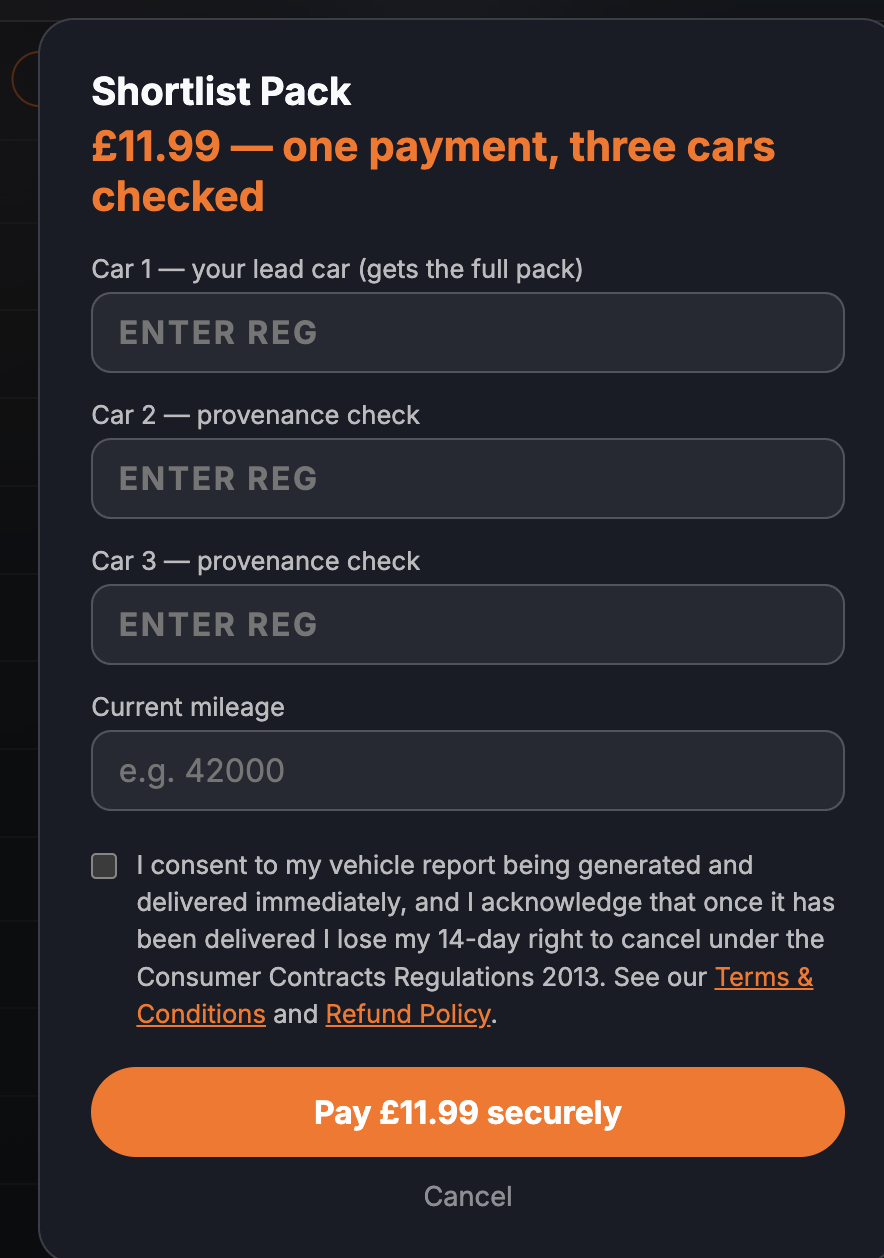
The pack page describes it in one line: it “runs the provenance check on three different cars, then the full Essential extras on your final pick”. Read literally, that means two different scopes inside one pack.
| Report | Car 1 | Cars 2 and 3 |
|---|---|---|
| Full Provenance Report | Yes | Yes |
| Safety Recall Check | Yes | No |
| Current Valuation (UKVD) | Yes | No |
| Car Tax (VED) | Yes | No |
| Spec & Options | Yes | No |
| Full Vehicle Identity | Yes | No |
Car 1 therefore receives the same six reports as the Essential Pack. Cars 2 and 3 receive the provenance report and nothing else.
2. Why the Provenance Report Is the One Worth Tripling
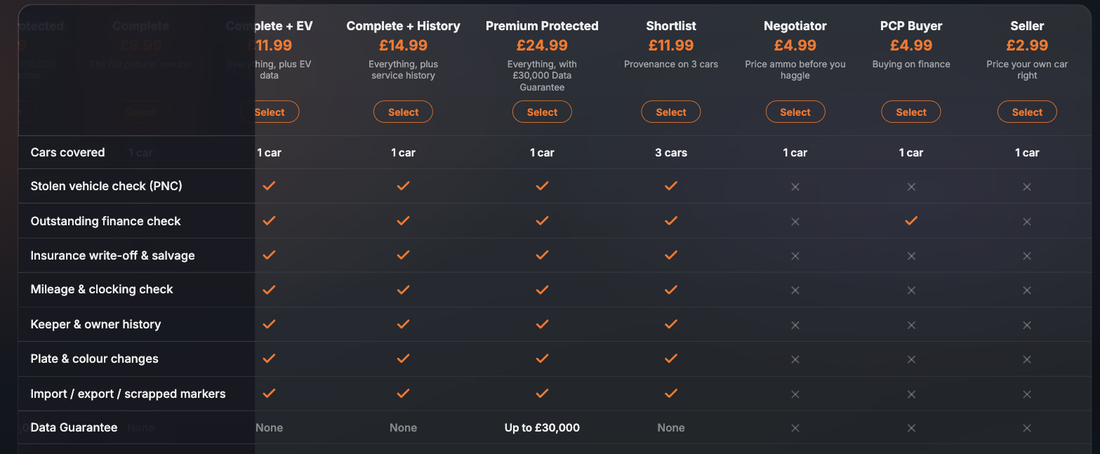
If you are only going to run one report on a car you may not buy, the Full Provenance Report is the right one, because it is the report that ends conversations. It carries the stolen vehicle check against the Police National Computer — if any of your three comes back flagged, do not buy it and contact the police on 101 — the outstanding finance check, the insurance write-off and salvage check, the mileage and clocking check, the keeper and owner history, the plate and colour history, and import, export and scrapped markers. Provenance data is provided by Experian.
Those seven areas are the ones where the answer is not “this car is a bit worse than I hoped” but “do not buy this car”. A clocked odometer or an unsettled finance agreement takes a car off your list in one line. A car tax figure, by contrast, never does.
That distinction is precisely the packs page’s own reasoning for not running the extras three times: “valuation, tax and spec only matter for the car you actually buy — running them on cars you reject would just make the pack dearer.”
3. The Three Steps on the Page
The pack page sets the process out in three steps, and they are worth following in order:
- Check all three for deal-breakers. Three provenance reports, three registrations, one sitting at the kitchen table.
- Pick your winner. Some of the three will have dropped out on the provenance evidence alone.
- The final choice gets the extras. Recall, valuation, car tax, spec & options and vehicle identity all run on that car.
At the buy step you will be asked for the registration and the current mileage. Mileage matters because the mileage and clocking analysis reads your figure against the recorded history — give the reading on the clock as the seller shows it, not the figure from the advert if the two differ.
You will also be asked to agree the consent line, which is worth reading rather than clicking past: “I consent to my vehicle report being generated and delivered immediately, and I acknowledge that once it has been delivered I lose my 14-day right to cancel under the Consumer Contracts Regulations 2013.” Reports are built and delivered on the spot, and that is the trade-off for immediate delivery.
Check a Car’s Full History
Check its history before you buy — free DVLA and MOT data in seconds.
4. When to Run It
Run the pack while all three cars are still live. The whole value of a shortlist check is that it is a filter applied before you spend a day travelling, and a pack bought after two of the three adverts have gone is a pack that has lost two thirds of its point.
The practical sequence that gets the most out of £11.99 looks like this:
- Run the free car check on each registration first. That covers DVLA vehicle data, MOT history, tax status and ULEZ/CAZ, and it costs nothing. It will sometimes remove a car from the list before you have spent anything at all.
- Rank whatever survives. Put the car you would most likely buy at number one — more on that in the next section.
- Buy the Shortlist Pack and enter all three registrations in that order.
- Read the three provenance reports before you arrange a single viewing.
- Take the reports with you when you go and check the physical car against them: VIN plate, colour, plate history, the odometer reading.
5. The Honest Limitation
Here is the part that deserves plain words. The five Essential extras run on car 1 only, and they are spent when they run. If car 1 comes back with a serious provenance finding — an unsettled finance agreement, a write-off marker, a mileage discrepancy — the pack has done the most valuable half of its job, because you have avoided the car. But the recall check, valuation, car tax, spec and identity reports were used on a car you are now not buying, and they do not move across to car 2 or car 3.
What you still hold in that situation is worth naming, because it is not nothing:
- A provenance report on car 2 and on car 3, unused and complete.
- The evidence that took car 1 off your list, which is the finding that would have cost you the most.
What you would then need for whichever car you switch to is the five extras on that registration. You can buy them individually from the Paid Check builder, or buy the Essential Pack (£5.99) for that car and accept that its provenance report duplicates the one you already have.
The way to reduce the chance of that is simple: make car 1 the car you are most likely to buy, not the cheapest, not the nearest, and not the one whose advert you happened to open first. Rank on how likely you are to actually hand over money.
Two other limits are worth stating. The Shortlist Pack has no Data Guarantee — it is marked None in that column, which the packs page explains as including “the full provenance report without a Data Guarantee — the report is informational only”. And it contains none of the forecasting reports: no future value and depreciation, no running cost per mile, no desirability rating. Those sit in the Complete Pack and above.
6. Price, and What the Same Reports Cost Separately
Every pack is a bundle of the same reports you can buy individually — priced lower than buying them one by one.
| Pack | Pack price | Same reports separately | Difference |
|---|---|---|---|
| Essential Pack (1 car) | £5.99 | £17.94 | £11.95 |
| Shortlist Pack (3 cars) | £11.99 | £29.92 | £17.93 |
| Complete Pack (1 car) | £8.99 | £28.89 | £19.90 |
The Shortlist “separately” figure is the Essential Pack’s six reports for car 1 plus a Full Provenance Report each for cars 2 and 3. Prices are as shown on the site at the time of writing; the page price is always the price you pay.
One comparison it is fair to make yourself: if your shortlist is genuinely down to two cars rather than three, two Essential Packs at £5.99 each is a different shape of purchase from one Shortlist Pack, and gives full extras on both. If it is three cars and you know which one you want, the Shortlist Pack is the one built for it.
Final Thoughts
The Shortlist Pack answers a specific question — which of these three cars is not worth driving to see — and it answers it for £11.99 in one payment. Its design is deliberate rather than mean: provenance on all three because that is what rules cars out, extras on one because those only matter for the car you buy. Understand that the extras land on car 1 and stay there, rank your three honestly before you enter them, and the pack does what it is for.
This guide provides general information and is not legal or financial advice. Provenance data in the Shortlist Pack is provided by Experian and covers all three registrations you enter; the other five Essential reports run on car 1 only and are not transferred if you go on to buy a different car, so the most common mistake with this pack is entering the cheapest or nearest car as car 1 rather than the one you are most likely to buy. The Shortlist Pack carries no Data Guarantee and its provenance report is informational only. SortedCars is independent: we do not sell cars, we do not list sellers, and we receive no commission from any provider mentioned in this article.
Frequently Asked Questions
Check Any Car’s History for Free
MOT history, mileage analysis, and DVLA data — completely free with SortedCheck.