Two questions decide whether a used car is a bargain or a burden, and neither is on the windscreen. How much will it cost to fuel at the miles you actually drive? And how much life does it have left? A cheap car that drinks fuel, or one near the end of its road life, is not cheap.
The Running Cost & Longevity report answers both before you commit: what is the fuel cost per mile for this car at my mileage, and how much longer is it likely to stay on the road? This guide explains what the two parts show, where the figures come from, what they cannot tell you, and how to use them.

1. What the Running Cost & Longevity Report Is
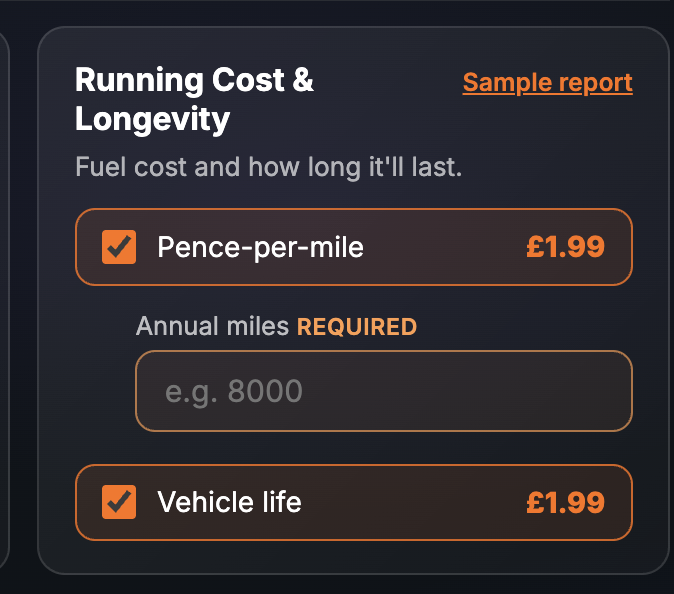
It is a paid report inside the SortedCars Paid Check builder, and it comes in two parts you can tick separately. Pence-per-mile costs £1.99 and Vehicle life costs £1.99. Tick one or both, enter the registration, and the report is built while you wait and shown on screen.
On the Paid Check page the card is titled Running Cost & Longevity with the strapline “Fuel cost and how long it’ll last”. Pence-per-mile has a required input: your annual miles. The annual fuel cost is worked out from that figure, so enter the mileage you expect to do. With both parts ticked, the report’s coverage line reads “2 paid reports + DVLA vehicle details” and its header carries a “NO DATA GUARANTEE” badge.
2. What the Report Shows
The finished report opens with the vehicle details from the DVLA — registration, make, model, colour, year and fuel — then the Pence-per-mile section, then the Vehicle Life section. Every screenshot below is sample data from our test environment: the registration is an official DVLA test number and the pence, pound and year figures are fixed test records, not a real car and not real prices.
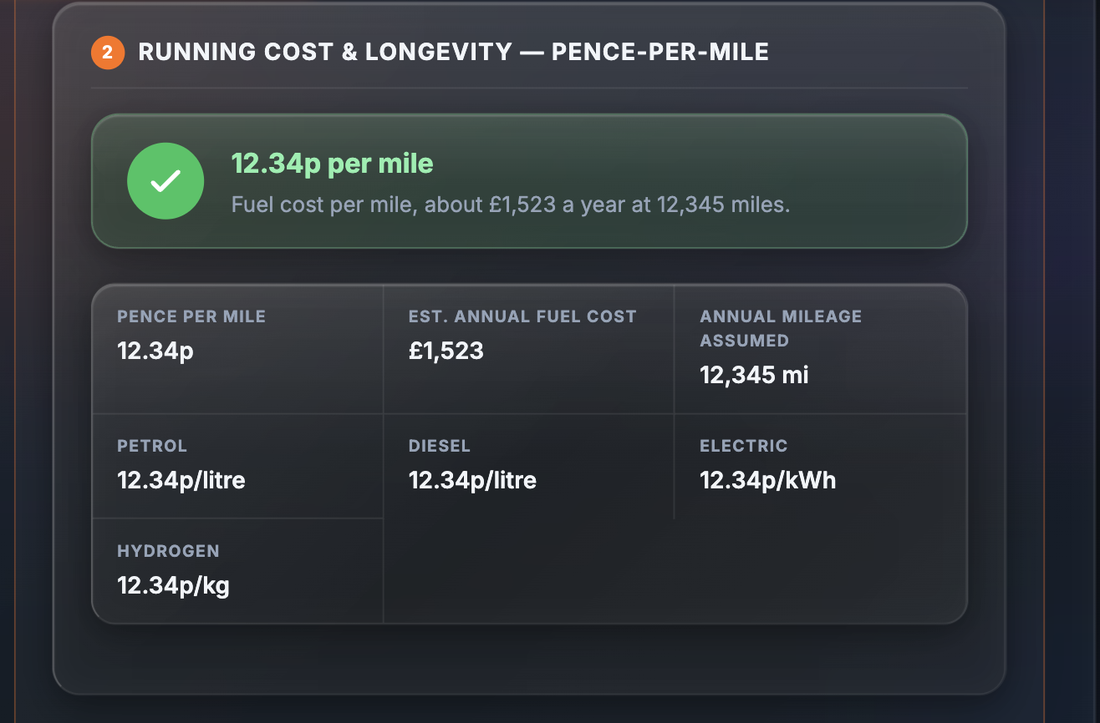
The Pence-per-mile section leads with a verdict — the fuel cost per mile, and what that comes to a year at your mileage — and then shows the figures and the assumptions behind them:
| Field | What it tells you |
|---|---|
| Pence per mile | The fuel cost of driving one mile in this car, based on its official consumption data and the fuel price assumed |
| Est. annual fuel cost | Pence per mile multiplied over your annual mileage, in pounds |
| Annual mileage assumed | The mileage you entered. Check it is what you meant; the annual cost scales with it |
| Petrol (p/litre) | The petrol price the model assumed |
| Diesel (p/litre) | The diesel price the model assumed |
| Electric (p/kWh) | The electricity price the model assumed |
| Hydrogen (p/kg) | The hydrogen price the model assumed |
The fuel price assumptions are shown so you can judge the result. If you pay less on an overnight tariff, or more at your local pump, you can see how far the figure would move.
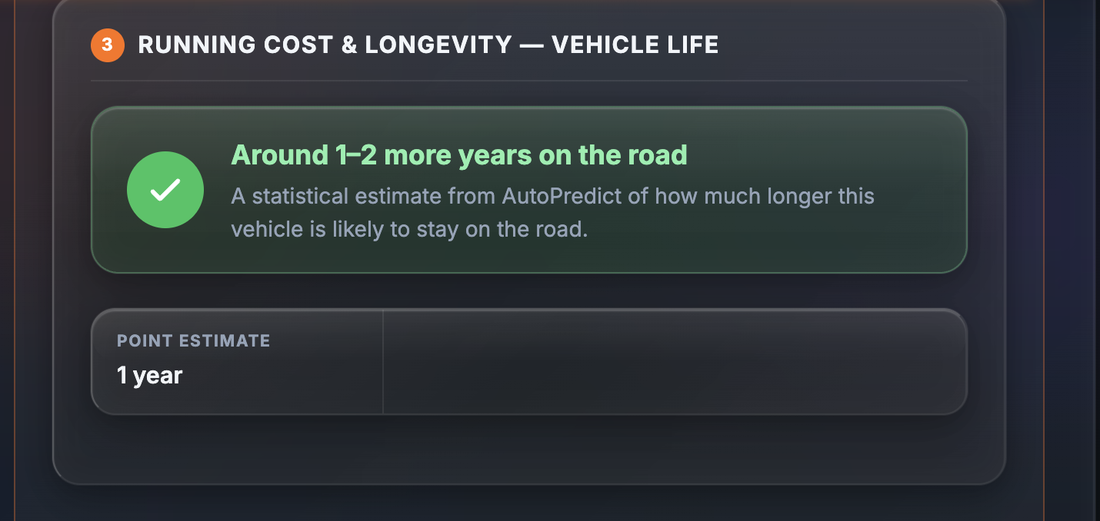
The Vehicle Life section is shorter. It leads with a verdict — around how many more years the vehicle is likely to stay on the road — and gives one figure:
| Field | What it tells you |
|---|---|
| Point estimate (years) | The single best-estimate number of further years on the road, from a statistical model of vehicles like this one. The verdict line gives it as a range around that point |
3. Why It Matters
Fuel is the running cost you pay every week, so a small difference per mile becomes a large one over a year. Consumption figures in miles per gallon or miles per kWh are hard to turn into money in your head. Pence per mile, at your mileage, is the number you can set against your budget.
It also makes cars comparable across fuel types. A petrol, a diesel and an electric car at similar prices have very different fuel economics, and the answer depends on how far you drive. The same report on each, with the same annual mileage, shows the difference in pounds.
Remaining life is the cost buyers think about last. Every car reaches a point where the next repair costs more than the car is worth and it leaves the road. An estimate of how far away that point is helps you weigh a low price against a short horizon, and decide whether the car is worth investing in or one to run gently and replace.
Neither figure replaces the checks on the car itself. Fuel type, engine and first registration are on the V5C; the MOT history at gov.uk/check-mot-history shows what testers have found, and is included in the free SortedCars check.
4. Where the Data Comes From
The Pence-per-mile figures are provided by Solifi. They are a model built from the vehicle’s official consumption data, the fuel price assumptions shown in the report and the annual mileage you enter. The Vehicle Life estimate is provided by AutoPredict, a statistical estimate of how much longer a vehicle like this one is likely to stay on the road. The vehicle details at the top of the report come from the DVLA, with MOT-related vehicle data from the DVSA. The report’s source line reads “DVLA · Solifi · AutoPredict”.
SortedCars does not hold or create these models. We ask Solifi and AutoPredict for the figures on the car at the moment you build the report and show you every value we receive.
5. What It Cannot Tell You
An honest estimate comes with honest limits.
- The fuel figure is a model, not your driving. It is based on official consumption data and assumed fuel prices and mileage. Short urban trips, a heavy right foot, a roof box or cold weather all push real consumption away from the official figure.
- Fuel prices move. The assumptions in the report are the ones the model used at the time it was built. The pump or the tariff you pay may differ, and will change over the time you own the car.
- It is fuel only. Servicing, tyres, tax and insurance are not in this section. The Servicing & Repair Forecast and Car Tax (VED) report cover those.
- Vehicle life is a statistical estimate, not an inspection. It describes vehicles like this one; it has not looked at this one. A well-kept car can outlast the estimate and a neglected one can fall short.
- It is not a forecast of value. How long a car stays on the road and what it will be worth are different questions. The Future Value & Depreciation report covers value.
- It is not a history check. Finance, stolen, write-off and mileage are separate reports, covered in our Car History guides.
Check a Car’s Full History
Check its history before you buy — free DVLA and MOT data in seconds.
6. What To Do With the Result
Step 1 — Check the mileage assumed. If it is not the figure you expect to drive, the annual cost is wrong. Rebuild with the right number rather than adjusting in your head.
Step 2 — Compare the fuel price assumptions with what you pay. If your electricity tariff or local pump price is different, scale the pence-per-mile figure accordingly. The assumptions are shown for exactly this reason.
Step 3 — Run it on every car on your shortlist. Use the same annual mileage each time so the comparison is fair. The Shortlist Pack covers three cars.
Step 4 — Weigh the point estimate against the price. A short expected life is not a reason to walk away on its own, but it should change what you pay and how much you plan to spend on the car.
Step 5 — Read it with the MOT history and an inspection. Advisories, rust and the service record tell you where this particular car sits against the estimate.
If a car bought from a trader turns out not to be as described, Citizens Advice explains your rights.
7. Price and Where It Sits
| How to buy it | Price | What you get |
|---|---|---|
| Pence-per-mile on its own | £1.99 | The fuel cost section plus the DVLA vehicle details |
| Vehicle life on its own | £1.99 | The remaining-life section plus the DVLA vehicle details |
| Complete Pack | £8.99 | Both parts alongside the valuation and other running-cost reports |
| Complete + EV Pack | £11.99 | Complete Pack with the electric-vehicle reports; includes both parts |
| Complete + History Pack | £14.99 | Complete Pack with the history reports; includes both parts |
| Premium Protected Pack | £24.99 | The full set of reports with protection included; includes both parts |
Neither part is in the Full Provenance Report. Prices are as shown on the site at the time of writing; the page price is always the price you pay.
Final Thoughts
Fuel cost per mile and remaining road life are the two running-cost questions that turn a purchase price into a cost of ownership. For £1.99 each, this report gives you a modelled answer to both, with the assumptions shown so you can adjust them to your own driving and prices.
Treat both figures as estimates from models that have not seen the car. Check the mileage assumed, compare the fuel prices with your own, and read the result alongside the MOT history and a proper look at the car. Then decide what it is really worth to you.
This guide provides general information and is not legal or financial advice. The Pence-per-mile figures are provided by Solifi and the Vehicle Life estimate by AutoPredict at the time the report is built; the fuel figure is a model based on official consumption data and assumed fuel prices and mileage, not your actual driving, and the vehicle life figure is a statistical estimate, not an inspection of this car. SortedCars resells the data named above and has no other connection with the providers, garages or insurers mentioned.
Frequently Asked Questions
Check Any Car’s History for Free
MOT history, mileage analysis, and DVLA data — completely free with SortedCheck.