A car’s registration can change. A private plate goes on when someone buys it and comes off again when they sell the car. A cherished mark follows its owner from one car to the next. The colour can change too — a respray after a bump, a wrap, or a full change of shade. None of this is illegal. But each change breaks the trail. An old advert, an old photo, a receipt from a garage — all of it sits under the old plate or the old colour, and you will not find it unless you know what the old plate was.
The Plate & Colour History check answers one question before you buy: has this car’s registration or colour changed since it was first registered, and when? This guide explains what the two parts show, where the data comes from, what they cannot tell you, and what to do with the answer.

1. What the Plate & Colour History Check Is
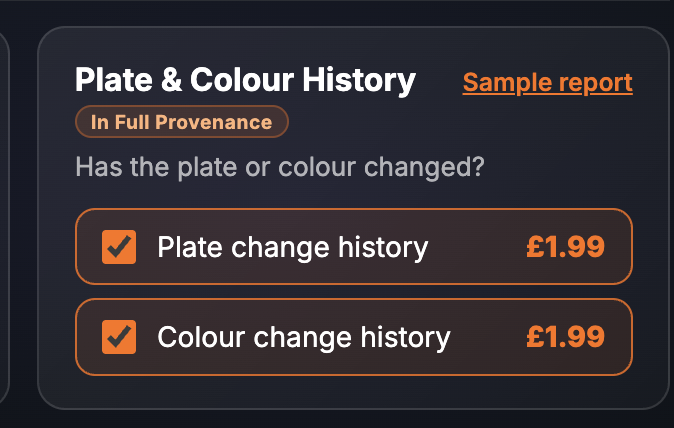
It is a card inside the SortedCars Paid Check builder with two parts, each priced separately: Plate change history at £1.99 and Colour change history at £1.99. You enter the registration, tick one part or both, and the report is built while you wait and shown on screen.
The card asks “Has the plate or colour changed?” and carries the In Full Provenance badge, which means both parts are also included inside the Full Provenance Report. Because both parts are Experian sections, the finished report also carries the six standard Experian identity sections before the parts you paid for. With both parts ticked, the report header describes its coverage as “2 paid reports + DVLA vehicle details”.
2. What the Report Shows
The finished report opens with the vehicle details from the DVLA, then the six Experian identity sections (Vehicle Description, Identity & Matching, Status Markers, a Plate & Colour History summary, V5C & Physical Identity Checks, and Technical & Industry Codes), and then the two sections you paid for: Plate change history and Colour change history. Every screenshot below is sample data from our test environment: the registration is an official DVLA test number and the plates, dates and colours are fixed test records, not a real car.
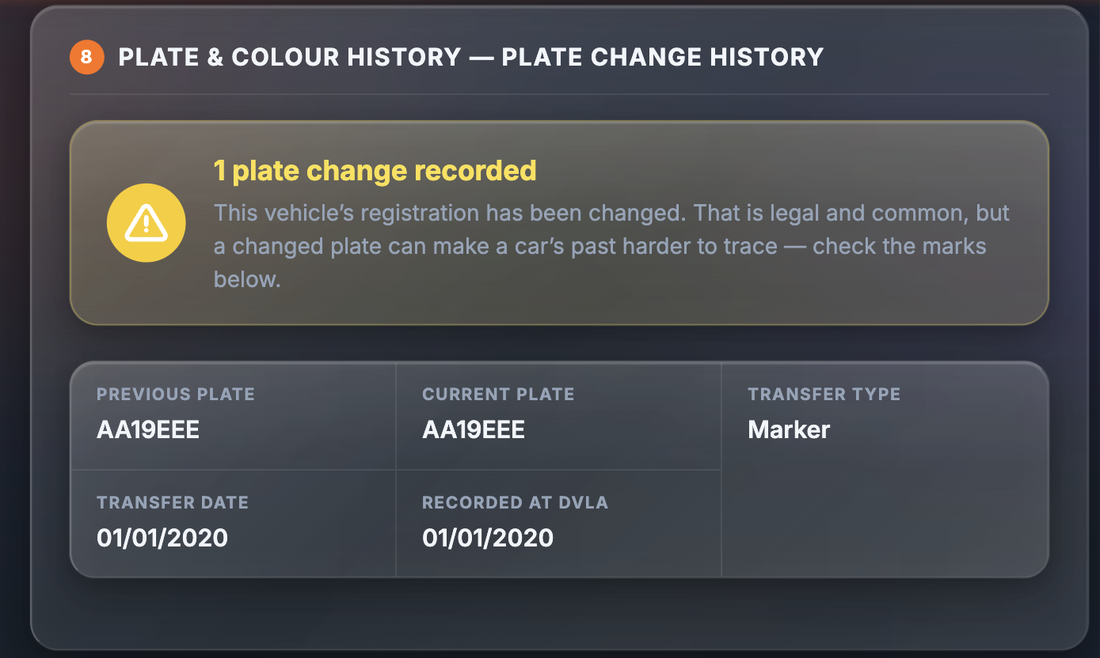
The plate section opens with a verdict. In the sample it reads: “1 plate change recorded — This vehicle’s registration has been changed. That is legal and common, but a changed plate can make a car’s past harder to trace — check the marks below.” For each change, the report lists:
| Field | What it tells you |
|---|---|
| Previous plate | The registration the car carried before the change — the mark to search under |
| Current plate | The registration it carries now. Check it matches the plates on the car and the V5C |
| Transfer type | How the change was recorded, for example “Marker” |
| Transfer date | The date the plate changed |
| Recorded at DVLA | The date the DVLA recorded the change. It can differ from the transfer date |
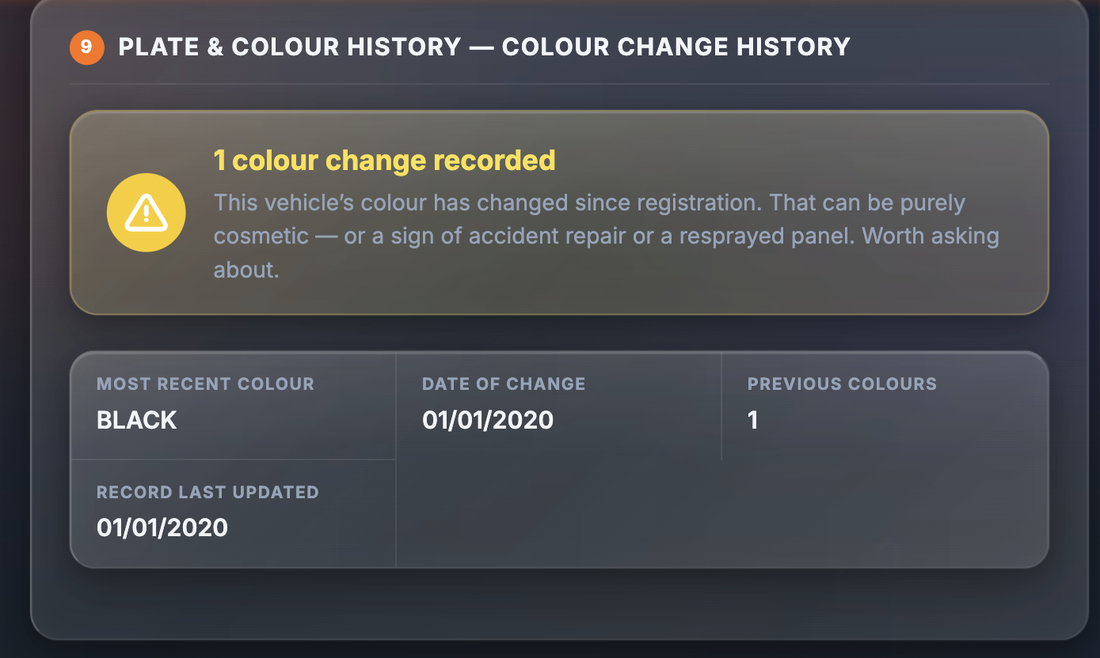
The colour section has its own verdict. In the sample it reads: “1 colour change recorded — This vehicle’s colour has changed since registration. That can be purely cosmetic — or a sign of accident repair or a resprayed panel. Worth asking about.” Below the verdict, the report lists:
| Field | What it tells you |
|---|---|
| Most recent colour | The colour on record now. Compare it with the car and the V5C |
| Date of change | When the most recent colour was recorded |
| Previous colours | How many colours the car has been recorded in before this one — a count, not a list |
| Record last updated | When the record was last updated |
If no change is on record, each section says so plainly.
3. Why It Matters
Private and cherished plate transfers are legal and common. The report says so in its own verdict. The point of the check is not to catch a crime; it is to let you trace the car’s past under its old marks.
Here is the practical problem. If the car wore a different plate two years ago, then the advert it was sold in, the photos of it, and any receipts or invoices from that period carry the old plate. Search under the current plate and you find nothing; search under the previous plate and the history appears. The MOT history is different: it follows the vehicle, not the plate, so the free MOT history checker on gov.uk shows the tests under the current registration. Our guide to reading MOT history before buying explains what to look for once you have it.
A colour change is a different kind of signal. It can be purely cosmetic. It can also be the visible trace of accident repair or a resprayed panel. A colour that changed on a particular date is a question for the seller: why, who did the work, and is there an invoice? Look at the car in daylight for a shade that does not quite match from one panel to the next, paint on rubber seals, or overspray inside the door shuts.
There is also the identity angle. A cloned car wears the plate of a genuine car of the same make, model and colour. A recent plate change or a colour that does not match the V5C is one of the small signs that, together with the Identity & Matching section, can point to a cloned vehicle. Our guide to spotting a cloned car covers that in detail.
4. Where the Data Comes From
The plate and colour change records in this check are provided by Experian; the report header shows the source as DVLA and Experian. The vehicle details at the top of the report come from the DVLA. Both sections carry the line “Data provided by Experian”.
SortedCars does not hold or create plate or colour records. We ask Experian for the record on the car at the moment you build the report and show you every value we receive.
5. What It Cannot Tell You
An honest check comes with honest limits.
- It does not say why. The report shows that a plate or colour changed and when. It cannot tell you whether the plate was a private mark, or whether the colour change followed a crash. Those are questions for the seller.
- A colour change is not proof of damage. The verdict says it plainly: it can be purely cosmetic. Treat it as a reason to look and ask, not as a verdict on the car.
- Previous colours is a count. It tells you how many colours came before, not what each of them was.
- Only recorded changes appear. The check shows what is on the record at the time the report is built. A change that has not yet reached the record will not be in it, and the Recorded at DVLA date can lag the transfer date.
- It is a snapshot. The result is correct at the moment the report is built. Run it close to the day you pay.
- It is not a finance, stolen or write-off check. Those are separate reports on the same page. The Full Provenance Report brings them together with plate and colour history for £5.99.
Check a Car’s Full History
Check its history before you buy — free DVLA and MOT data in seconds.
6. What To Do With the Result
A change on record is a lead, not a problem. Here is how to follow it.
Step 1 — Search under the previous plate. Put the old registration into the places you would normally search for a car’s past: old adverts, photos, and any paperwork the seller has. Ask the seller directly whether they have service invoices or receipts that carry the old mark.
Step 2 — Check the current plate against the car and the V5C. The registration on the report, on the number plates and in the V5C logbook should match. If they do not, stop and read our V5C logbook guide and the gov.uk guidance on buying a vehicle before going any further.
Step 3 — Ask about the colour. If a colour change is recorded, ask the seller why, when and who did the work. A full respray with an invoice from a bodyshop is a very different answer from a shrug. Compare the Most recent colour with the colour on the V5C and with the car in front of you.
Step 4 — Inspect the paintwork. Look along each panel in daylight. Check for a shade that differs between panels, paint on the rubber seals or trim, and overspray inside the door shuts, boot and bonnet edges. These are the usual traces of a resprayed panel.
Step 5 — Check the plate itself is legal. A private plate must still follow the rules on format, font and spacing, and it cannot make a car look newer than it is. Our number plate rules page explains what makes a plate legal, and our number plates guide lets you look up the age code on any plate.
7. Price and Where It Sits
| How to buy it | Price | What you get |
|---|---|---|
| Plate change history on its own | £1.99 | The plate change section plus the DVLA vehicle details and the Experian identity sections |
| Colour change history on its own | £1.99 | The colour change section plus the DVLA vehicle details and the Experian identity sections |
| Full Provenance Report | £5.99 | Plate and colour history together with finance, stolen, write-off, mileage and keeper history — provenance data provided by Experian |
Neither part is sold inside a Car Check Pack on its own, but every pack from the Essential Pack (£5.99) upwards includes the Full Provenance Report, so both sections are inside all of those. Prices are as shown on the site at the time of writing; the page price is always the price you pay.
Final Thoughts
A changed plate or a changed colour is not a reason to walk away. It is a reason to look harder. The plate check gives you the old mark to search under; the colour check gives you a date and a question to put to the seller.
Each part costs £1.99 and is built while you wait. Run it before you view the car, write down the previous plate, and then go and look at the paintwork with the answer in your pocket.
This guide provides general information and is not legal advice. Plate and colour change data in this check is provided by Experian from records held by the DVLA and shows the changes on record at the time the report is built; it cannot show a change that has not yet reached the record, and it cannot tell you why a plate or colour was changed. If a car’s plate, VIN and V5C do not match, report it to the police on 101. SortedCars resells the data named above and has no other connection with the providers, garages or insurers mentioned.
Frequently Asked Questions
Check Any Car’s History for Free
MOT history, mileage analysis, and DVLA data — completely free with SortedCheck.