“One owner from new” is one of the oldest lines in a used-car advert, and one of the easiest to say. The V5C in the seller’s hand shows the current keeper and a count of former keepers, but a V5C can be recent, and the seller may not be the person named on it. What you want is the number as the DVLA holds it, on a date you can trust.
The Keeper & Owner History check answers one question before you hand over any money: how many registered keepers has this car had, and when did it last change hands? This guide explains what the check shows, where the data comes from, what it cannot tell you, and what to do with the number once you have it.

1. What the Keeper & Owner History Check Is
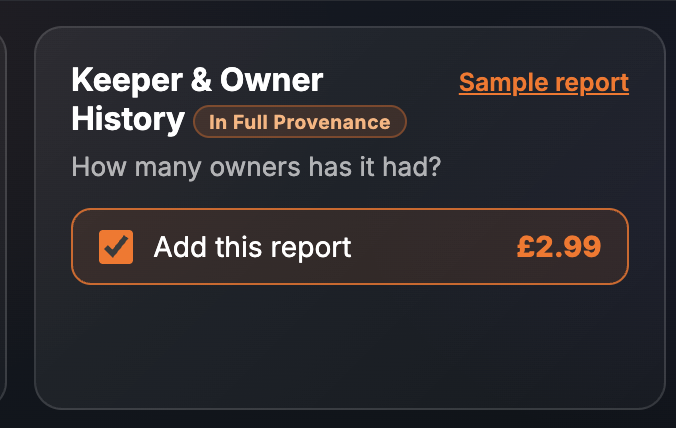
It is a single paid report inside the SortedCars Paid Check builder. You enter the registration, tick the check, and the report is built while you wait and shown on screen. It costs £2.99 on its own.
You will find it on the Provenance tab, alongside the other checks that carry the “In Full Provenance” badge. The card asks “How many owners has it had?” The badge means the same check is also included inside the Full Provenance Report.
2. What the Report Shows
The finished report opens with the vehicle details from the DVLA, then the six Experian identity sections, and ends with section 8, the Keeper & Owner History. The header shows the coverage as “1 paid report + DVLA vehicle details”, the source as “DVLA · Experian”, and a “NO DATA GUARANTEE” badge. Every screenshot below is sample data from our test environment: the registration is an official DVLA test number and the keeper count and dates are fixed test records, not a real car.
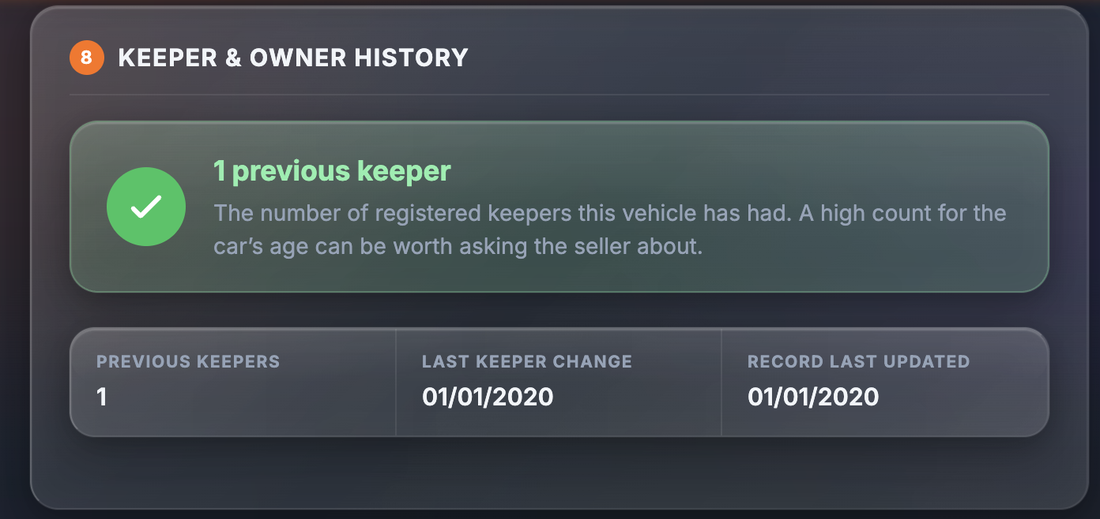
The section opens with a verdict giving the count — in the sample, “1 previous keeper” — and the note that this is the number of registered keepers the vehicle has had, and that a high count for the car’s age can be worth asking the seller about. Below the verdict are three fields:
| Field | What it tells you |
|---|---|
| Previous keepers | How many registered keepers the car has had before the current one. Compare it with the number on the V5C |
| Last keeper change | The date the car was last registered to a new keeper. A change only weeks ago is a question for the seller |
| Record last updated | When the record was last updated by the source |
That is the whole section: a count, the date of the last change, and the date of the record. It does not list each keeper in turn and it does not carry names or addresses. The section ends with the line “Data provided by Experian”.
3. Why It Matters
The keeper count is context for everything else. A ten-year-old car with three previous keepers has had an ordinary life. A three-year-old car with five has been passed on quickly, and the reason is worth knowing: it may be a fault nobody could fix, a car bought and sold by traders, or simply bad luck. The number does not tell you which. It tells you to ask.
The last change date matters for a different reason. A seller who has only just become the keeper may be a trader selling privately, or someone who found a problem and wants it gone. A car that has changed hands twice in a few months is a car that two people decided not to keep.
Our guide on keeper changes and what they mean goes into how to read a keeper count against the car’s age; this guide does not repeat it. The V5C side of the story — what the logbook shows and how to check the seller is the person named on it — is covered in our V5C logbook guide, and the DVLA’s own advice on checking a vehicle before you buy is at gov.uk/buy-a-vehicle.
4. Where the Data Comes From
The keeper records behind this check are held by the DVLA and supplied through our data provider. The section carries the line “Data provided by Experian”, and the report header names the source as “DVLA · Experian”. The vehicle details at the top of the report come from the DVLA.
SortedCars does not hold or create keeper records. We ask the provider for the record on the car at the moment you build the report and show you every value we receive.
5. What It Cannot Tell You
An honest check comes with honest limits.
- It does not name anyone. Keeper names and addresses are personal data and are not part of the report. You get a count and a date.
- It is not a dated list of every keeper. The section shows the total count and the date of the last change only. It does not show when each earlier change happened.
- A keeper is not an owner. The registered keeper is the person responsible for the car, who may not be the legal owner. A car on finance is owned by the lender; a company car is owned by the company. The count is of keepers.
- It is a snapshot. The result is correct at the moment the report is built. A change registered after that date will not appear. Run it close to the day you pay.
- It is not a finance, stolen, write-off or mileage check. Those are separate reports on the same page. The Full Provenance Report bundles them together with the keeper history for £5.99.
Check a Car’s Full History
Check its history before you buy — free DVLA and MOT data in seconds.
6. What To Do With the Result
The keeper count is a number to interpret, not a verdict. Use it to check what you have been told and to decide what to ask.
Step 1 — Compare the count with the advert and the V5C. “One owner” should mean a count of one, or zero previous keepers if the seller is the first. The V5C shows the number of former keepers; the report count should agree with it. A mismatch means one document is out of date, or the seller is not telling the whole story.
Step 2 — Compare the last change date with the seller’s story. Ask how long they have had the car. Then look at the date. A seller who has been the keeper for a few weeks needs a good reason for selling so soon.
Step 3 — Check the seller is the keeper. The name and address on the V5C should match the person selling and the place you are viewing. If they do not, ask why. Our V5C guide covers what to look for.
Step 4 — Judge the count against the age. A high count for the car’s age is not a fault in itself. It is a reason to ask more questions, look harder at the service history, and price accordingly.
If a seller has misrepresented the car’s ownership history and you have already bought it, Citizens Advice can explain your rights as a buyer, and a deliberate deception can be reported to Action Fraud.
7. Price and Where It Sits
| How to buy it | Price | What you get |
|---|---|---|
| Keeper & Owner History on its own | £2.99 | The keeper section plus the DVLA vehicle details and Experian identity sections shown above |
| Full Provenance Report | £5.99 | Keeper history, finance, stolen, write-off, mileage and plate history in one report — provenance data provided by Experian |
The check is not sold inside a Car Check Pack on its own, but the Full Provenance Report that contains it is inside the packs from the Essential Pack (£5.99) upwards. Prices are as shown on the site at the time of writing; the page price is always the price you pay.
Final Thoughts
The keeper count is a small piece of data that checks a big claim. For £2.99, built while you wait, you get the number as the record holds it and the date the car last changed hands. Compare both with the advert, the V5C and the seller’s story, and ask about anything that does not fit.
Read it with our guide on what keeper changes mean, and if you are running the other provenance checks anyway, the Full Provenance Report includes this one.
This guide provides general information and is not legal advice. The Keeper & Owner History check shows keeper records held by the DVLA and supplied through our data provider, attributed in the report as data provided by Experian; it shows the count of previous keepers and the date of the last change at the time the report is built, does not list each keeper or any name or address, and cannot show a change registered after the report was built. A registered keeper is not necessarily the legal owner. SortedCars resells the data named above and has no other connection with the providers, garages or insurers mentioned.
Frequently Asked Questions
Check Any Car’s History for Free
MOT history, mileage analysis, and DVLA data — completely free with SortedCheck.