The asking price on a used car is whatever the seller decided to write. It may be fair or a hopeful opening number, and the advert alone will not tell you which. Before you agree a figure, you want an independent view of what cars like this one are actually worth today — at a dealer, privately, and as a part-exchange.
The Current Valuation report answers one question: what is this car worth right now, at the mileage you tell us? This guide explains what the report shows, where the figures come from, why two providers can give two different numbers, what a valuation cannot do, and how to use it when you negotiate.

1. What the Current Valuation Report Is
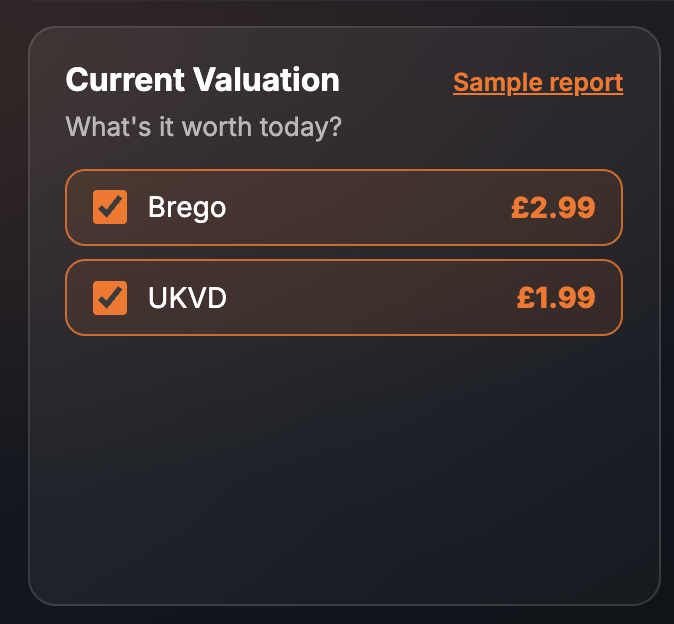
It is a paid report inside the SortedCars Paid Check builder. You enter the registration, tick the valuation you want, and the report is built while you wait and shown on screen. Unusually, this card offers two providers and you can buy either or both:
- Brego — £2.99. Retail and trade values with a range around each.
- UKVD (UK Vehicle Data) — £1.99. A fuller ladder of prices from dealer forecourt down to auction, plus the list price when new.
Tick both and the report contains two valuation sections, one after the other, so you can compare them side by side. The card is headed “Current Valuation — What’s it worth today?” on the Paid Check page.
The valuation is calculated at the mileage you enter. Put in the true mileage from the odometer, not a guess, or the figure you get back will be for a different car.
2. What the Report Shows
The finished report opens with the vehicle details from the DVLA and DVSA, then one section per valuation provider you chose. Every screenshot below is sample data from our test environment: the registration is an official DVLA test number and the values, dates and mileages are fixed test records, not a real car and not a real market price.
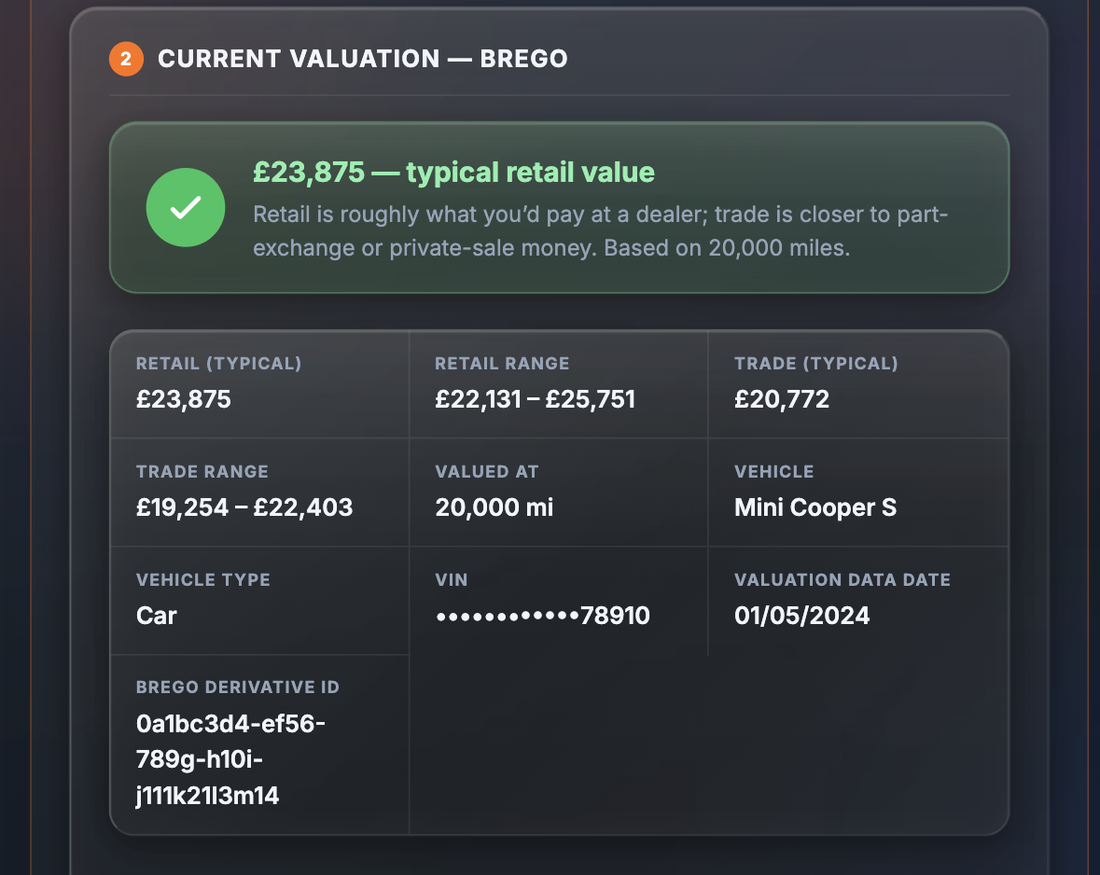
The Brego section gives a headline “typical retail value” and explains the two numbers underneath it: retail is roughly what you would pay at a dealer; trade is closer to part-exchange or private-sale money. The fields are:
| Field | What it tells you |
|---|---|
| Retail (typical) | The central estimate of a dealer price for this car at this mileage |
| Retail range | The low and high band around the retail figure |
| Trade (typical) | The central estimate of what the trade would pay — part-exchange or private-sale territory |
| Trade range | The band around the trade figure |
| Valued at (mileage) | The mileage the valuation assumes. Check it is the one you entered |
| Vehicle | The make and model Brego matched to the registration |
| Vehicle type | The body or vehicle class used for the valuation |
| VIN (masked) | Part of the chassis number, so you can confirm it is the right car |
| Valuation data date | The date the underlying pricing data was last refreshed |
| Brego derivative ID | Brego’s own reference for the exact derivative it valued |
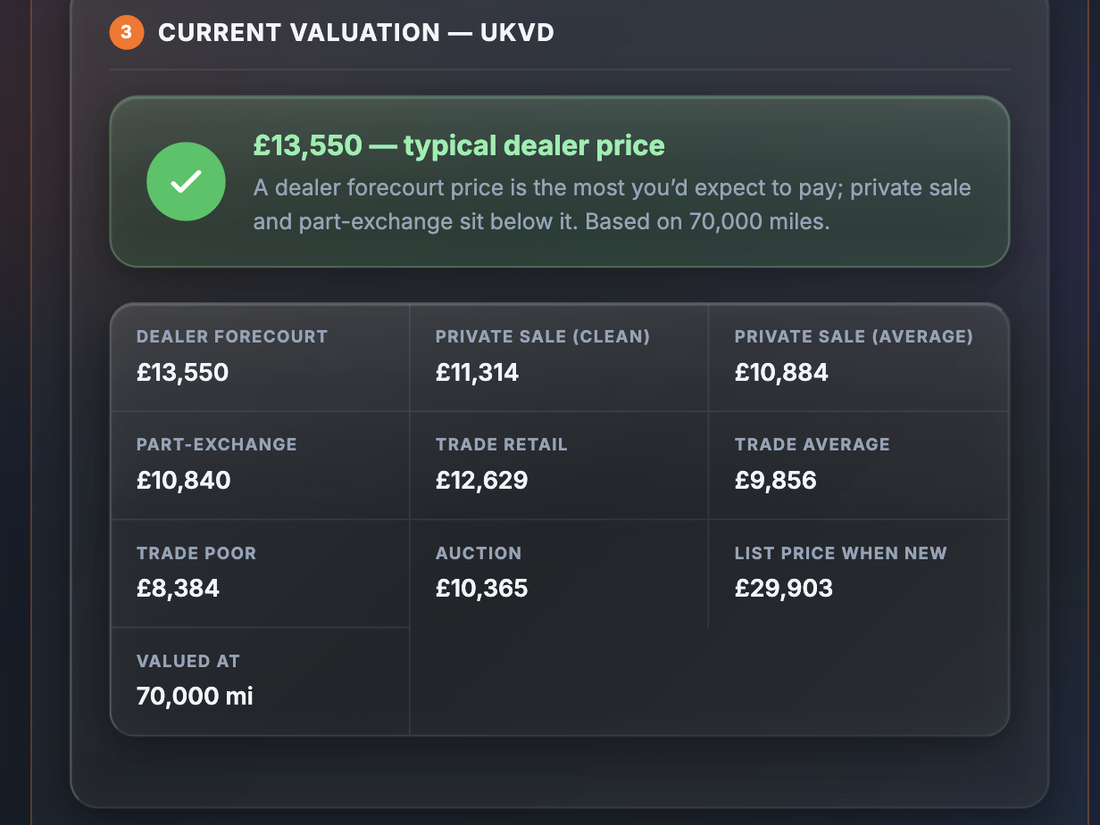
The UKVD section leads with a “typical dealer price” and notes that a dealer forecourt price is the top of the ladder; private sale and part-exchange sit below it. The fields are:
| Field | What it tells you |
|---|---|
| Dealer forecourt | What you would expect to pay buying from a dealer |
| Private sale (clean) | A private-sale price for a car in clean condition |
| Private sale (average) | A private-sale price for a car in average condition |
| Part-exchange | What a dealer might allow against another car |
| Trade retail | A trade-to-trade price for a retail-ready car |
| Trade average | A trade price for an average-condition car |
| Trade poor | A trade price for a car in poor condition |
| Auction | What the car might fetch at auction |
| List price when new | The original showroom price, useful for seeing how far it has fallen |
| Valued at (mileage) | The mileage the valuation assumes |
3. Why It Matters
Price is the one part of a used-car deal that is decided in a conversation. Walking into it with nothing but the seller’s number puts you at a disadvantage. Walking in with an independent retail, trade and private-sale figure gives you three anchors and a reason for the offer you make.
It matters in the other direction too. If the asking price sits well below the trade range, ask why. A cheap car is sometimes a bargain and sometimes a car with a problem the seller has priced in. Pair the valuation with the history checks in the Car History section before you get excited about a low number.
Sellers benefit as well. Knowing the forecourt, private-sale and part-exchange figures stops you accepting a trade price for a car you could have sold privately.
4. Where the Data Comes From
The two valuation sections are provided by Brego and provided by UK Vehicle Data respectively. Each provider matches the registration to a vehicle derivative and applies its own pricing model at the mileage you give. The vehicle details at the top of the report come from the DVLA and DVSA.
SortedCars does not hold or create valuation figures. We ask the provider you chose for the valuation at the moment you build the report and show you every value we receive. That is also why two providers can return two different numbers: they are two separate models, built from separate data, and the builder lets you add both precisely so you can compare them.
5. What It Cannot Tell You
A valuation is a model of the market, not a promise about one car.
- It is not an offer. Nobody is offering to buy or sell the car at these figures. They are estimates of what cars like this one change hands for.
- It cannot see the car in front of you. Condition, service history, bodywork, tyres and factory options all move real prices. The model values the derivative at the mileage given, not the specific example on the drive.
- It depends on the mileage you enter. A wrong mileage gives a wrong valuation. The report shows the mileage it used so you can check.
- Two providers can disagree. Different models, different data. Treat the gap between them as the honest width of the answer rather than a fault in either.
- It is not a history check. It does not tell you whether the car is clocked, written off or on finance. Those are separate reports; the Outstanding Finance Check is a good place to start.
Check a Car’s Full History
Check its history before you buy — free DVLA and MOT data in seconds.
6. What To Do With the Result
Step 1 — Place the asking price on the ladder. Is it above the dealer forecourt figure, between forecourt and private sale, or below trade? A private seller asking a forecourt price is asking you to pay for a warranty and a showroom they are not providing.
Step 2 — Adjust for the actual car. Full service history, recent tyres and a clean MOT record justify the upper end of the range. Missing history, cosmetic damage or advisories justify the lower end. Use the free MOT history and the guide to reading it to decide which.
Step 3 — Make a reasoned offer. Quote the figure and the mileage it was valued at. An offer backed by a dated valuation is easier to make and harder to dismiss than a round number.
Step 4 — Keep the report as a dated record of what the car was worth on the day.
Buying from a dealer gives you rights under consumer law that a private sale does not. GOV.UK has a checklist for buying a vehicle, and if something goes wrong after the sale, Citizens Advice explains your rights in plain terms. For help with the negotiation itself, see our Buyer Tips.
7. Price and Where It Sits
| How to buy it | Price | What you get |
|---|---|---|
| Brego valuation on its own | £2.99 | Retail and trade values with ranges, plus the DVLA vehicle details |
| UKVD valuation on its own | £1.99 | Dealer forecourt to auction price ladder and list price when new, plus the DVLA vehicle details |
| Seller Pack | £2.99 | Includes the UKVD valuation |
| Negotiator Pack | £4.99 | Includes the UKVD valuation |
| PCP Buyer Pack | £4.99 | Includes the UKVD valuation |
| Essential Pack and above | from £5.99 | Essential £5.99, Essential Protected £7.49, Complete £8.99, Complete + EV £11.99, Shortlist £11.99, Complete + History £14.99 and Premium Protected £24.99 all include the UKVD valuation |
The Brego valuation is not included in any Car Check Pack; it is bought on its own from the Paid Check page. Prices are as shown on the site at the time of writing; the page price is always the price you pay.
Final Thoughts
A valuation does not decide the price of a car. It gives you a reasoned place to start and a reasoned place to stop. For £1.99 or £2.99, built while you wait, that is cheap preparation for the one conversation where you can save real money.
Enter the true mileage, read the Valued at line, place the asking price on the ladder, and then adjust for the actual car. If you want a second opinion, tick both providers and let the gap between them tell you how firm the number really is.
This guide provides general information and is not legal or financial advice. Valuation figures in the Current Valuation report are provided by Brego and UK Vehicle Data and are model-based estimates at the mileage entered when the report is built; they are not offers to buy or sell, and the condition, history and options of an individual car will move its real price. Disputes with a dealer after a sale are a matter for the dealer first and then Citizens Advice. SortedCars resells the data named above and has no other connection with the providers, dealers or sellers mentioned.
Frequently Asked Questions
Check Any Car’s History for Free
MOT history, mileage analysis, and DVLA data — completely free with SortedCheck.