Many used cars in the UK are bought on finance. When a car is on hire purchase (HP) or a personal contract purchase (PCP), the finance company owns it until the final payment is made. The person driving it is the registered keeper, but not the owner. If that person sells the car to you before the agreement is settled, the finance company’s claim on the car does not disappear — it comes with the car.
The Outstanding Finance Check answers one question before you hand over any money: is there a finance agreement registered against this car? This guide explains what the check shows, where the data comes from, what it cannot tell you, and what to do if the answer is yes.

1. What the Outstanding Finance Check Is
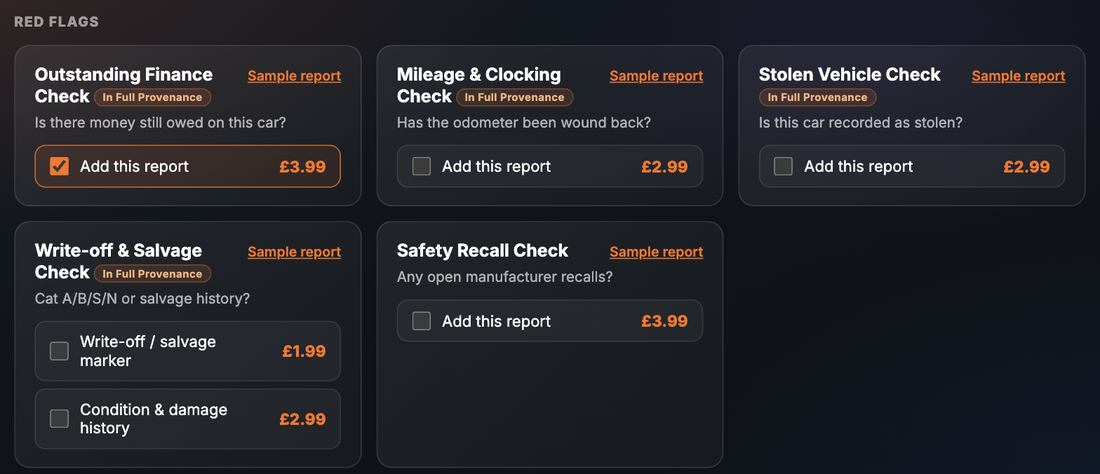
It is a single paid report inside the SortedCars Paid Check builder. You enter the registration, tick the check, and the report is built while you wait and shown on screen. It costs £3.99 on its own.
You will find it on the Provenance tab, in the Red flags group, next to the Mileage & Clocking Check and the Stolen Vehicle Check. The “In Full Provenance” badge means the same check is also included inside the Full Provenance Report.

2. What the Report Shows
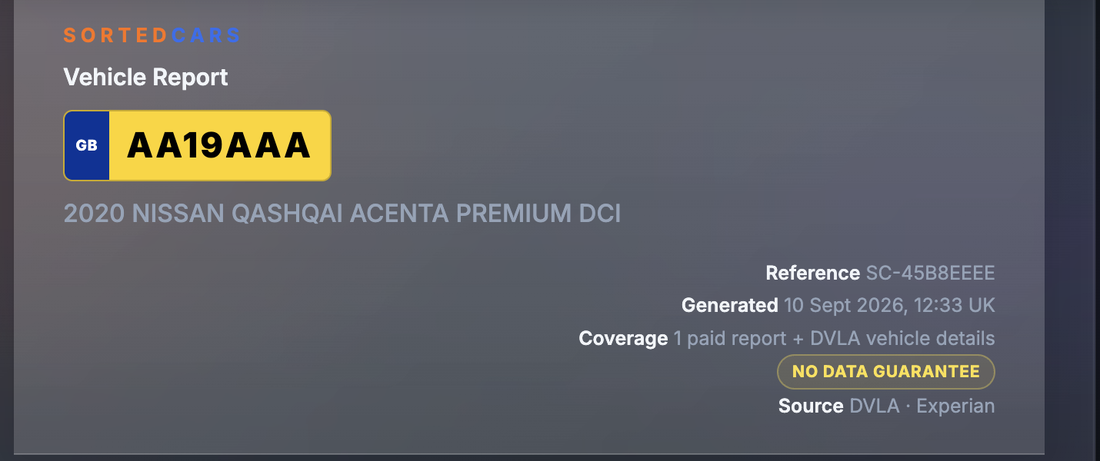
The finished report opens with the vehicle details from the DVLA, then the Experian identity sections, and ends with the Outstanding Finance section. Every screenshot below is sample data from our test environment: the registration is an official DVLA test number and the finance company, agreement number and dates are fixed test records, not a real car and not a real lender.
The Outstanding Finance section itself gives you a headline verdict and then the detail of each agreement found. This is what the section looks like when one agreement is on record:
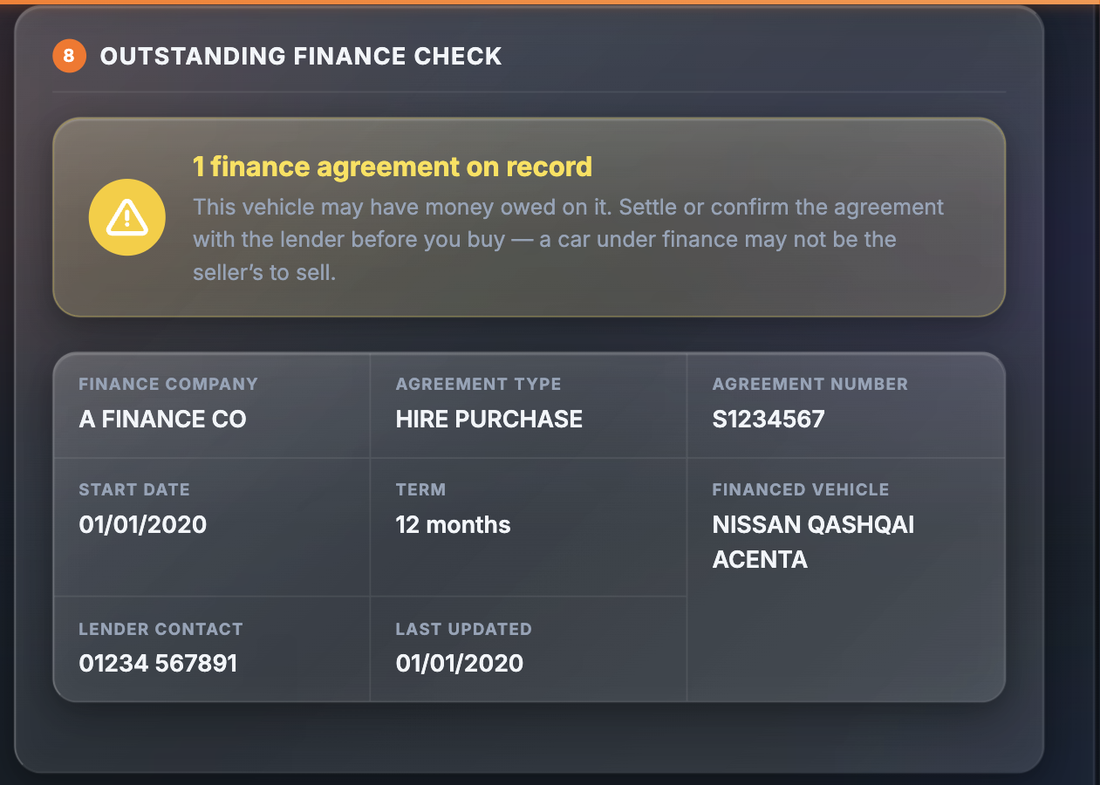
For each agreement, the report lists:
| Field | What it tells you |
|---|---|
| Finance company | The lender that registered the agreement — the company you or the seller must settle with |
| Agreement type | Hire purchase, PCP or conditional sale |
| Agreement number | The lender’s reference. Quote it when you call them |
| Start date | When the agreement began |
| Term | The agreed length in months. Start date plus term tells you when it was due to end |
| Financed vehicle | The make and model the lender recorded. Check it matches the car in front of you |
| Lender contact | A phone number for the finance company |
| Last updated | When the lender last updated the record |
If nothing is registered, the section says so plainly. A clear result is the normal outcome for most cars — but “clear” has limits, which we cover in section 5.
3. Why It Matters
Under HP, PCP and conditional sale, the lender keeps legal ownership of the car until the last payment. If the seller stops paying after you have bought it, the lender can pursue the car — and the car is now on your drive.
There is some protection in law. Part III of the Hire Purchase Act 1964 says that when a car under HP or conditional sale is sold to a private purchaser who buys in good faith and without notice of the agreement, the buyer gets good title. Three things to know about that protection:
- It is for private buyers only. A motor trader or a finance company buying the car is not protected.
- You must have acted in good faith and not known. If it is later disputed, you may need to show what you did to check. A dated finance check, done before you paid, is exactly that kind of evidence.
- It is a defence, not a shortcut. Relying on it means a dispute with a finance company after the event. Finding the finance first means no dispute at all.
There is also a plainer reason. A seller who does not mention finance on the car has either forgotten something important or is hiding it. Either way, you want to know before you decide how much to trust the rest of what they tell you.
4. Where the Data Comes From
The finance data in this check is provided by Experian. Finance companies register their HP, PCP and conditional sale agreements against the vehicle, and the check reads what has been registered for the registration you enter. The vehicle details at the top of the report come from the DVLA.
SortedCars does not hold or create finance records. We ask Experian for the record on the car at the moment you build the report and show you every value we receive.
5. What It Cannot Tell You
An honest check comes with honest limits.
- Only registered agreements appear. If a lender has not registered an agreement, the check cannot see it. Lenders register agreements so that exactly this kind of check can find them, but no check can promise that every agreement in existence is on the register.
- Personal loans do not appear — and do not matter here. A personal loan is a debt of the person, not the car. It is not secured on the vehicle, so the lender has no claim on the car and it is not registered against it.
- It does not show the amount left to pay. The report shows the lender, the type, the start date and the term. The settlement figure comes from the lender, and only the borrower can request it.
- It is a snapshot. The result is correct at the moment the report is built. An agreement settled yesterday may still show until the lender updates the record; an agreement taken out tomorrow will not be in today’s report. Run the check close to the day you pay.
- It is not a stolen, write-off or mileage check. Those are separate reports on the same page. The Full Provenance Report bundles them together with the finance check for £5.99.
Check a Car’s Full History
Check its history before you buy — free DVLA and MOT data in seconds.
6. What To Do If Finance Is Found
An agreement on record is not automatically a reason to walk away. Many perfectly genuine sellers still owe money on the car and plan to settle it from the sale. The difference between a safe purchase and a bad one is how it gets settled.
Step 1 — Tell the seller what the report shows. Name the finance company and the agreement type. A genuine seller will confirm it straight away. A seller who denies it, or says it was “paid off years ago”, needs to prove that with a letter from the lender before you go any further.
Step 2 — Ask for a settlement letter. The seller requests a settlement figure from the finance company. The letter states the amount needed to clear the agreement and the date that figure is valid to. Read it yourself. Check the registration and the lender name match the report.
Step 3 — Settle before, or as part of, the sale. The two safe routes are:
- The seller settles first and shows you the lender’s written confirmation that the agreement is closed. Then you pay the seller the full price.
- You pay the lender directly for the settlement amount, using the details on the settlement letter, and pay the seller only the balance. Get the lender’s confirmation that the agreement is closed.
Step 4 — Re-run the check before you drive away if there has been a gap of more than a few days. A second £3.99 report is cheap insurance against a settlement that was promised but never made.
If the seller will not produce a settlement letter, will not let you pay the lender directly, and pushes you to pay quickly, walk away. If you believe you were deliberately misled about finance on a car you have already bought, report it to Action Fraud. If your complaint is about how a finance company has treated you over the agreement, the Financial Ombudsman Service is the free route once you have complained to the lender first.
7. Price and Where It Sits
| How to buy it | Price | What you get |
|---|---|---|
| Outstanding Finance Check on its own | £3.99 | The finance section plus the DVLA vehicle details and Experian identity sections shown above |
| Full Provenance Report | £5.99 | Finance, stolen, write-off, mileage, keeper and plate history in one report — provenance data provided by Experian |
| PCP Buyer Pack | £4.99 | Finance check, current valuation, future value and car tax — built for buyers taking over or paying off a PCP car |
Every Car Check Pack from the Essential Pack (£5.99) upwards includes the Full Provenance Report, so the finance check is inside all of those too. Prices are as shown on the site at the time of writing; the page price is always the price you pay.
Final Thoughts
Outstanding finance is one of the few used-car problems that can cost you the whole car rather than a repair bill. The check that finds it costs £3.99 and is built while you wait. Run it before you pay, read the Term and Financed vehicle fields properly, and if finance is found, settle it with the lender directly or see written proof that the seller has. Then buy the car.
This guide provides general information and is not legal or financial advice. Finance data in the Outstanding Finance Check is provided by Experian and shows agreements lenders have registered against the vehicle at the time the report is built; it cannot show an agreement that has not been registered, or the amount left to pay. If a seller misleads you about finance on a car, report it to Action Fraud; disputes with a finance company go to the lender first and then the Financial Ombudsman Service. SortedCars is not a lender, credit broker, insurer or financial adviser. We receive no commission from any provider mentioned in this article.
Frequently Asked Questions
Check Any Car’s History for Free
MOT history, mileage analysis, and DVLA data — completely free with SortedCheck.