A car has three identities: the registration on its plates, the chassis number stamped into its body, and the engine number on the block. On a genuine car all three belong together and match the record. On a cloned car, the plates belong to a different vehicle. On a ringed car, the chassis plate may have been swapped from a written-off shell. Either way the car in front of you is not the car the paperwork describes, and it can be taken from you later.
The Full Vehicle Identity check answers one question before you buy: does this car’s plate, VIN and engine number match the identity on record, and is that identity clean? This guide explains what the seven sections show, where the data comes from, what the check cannot tell you, and what to do if something does not match.

1. What the Full Vehicle Identity Check Is
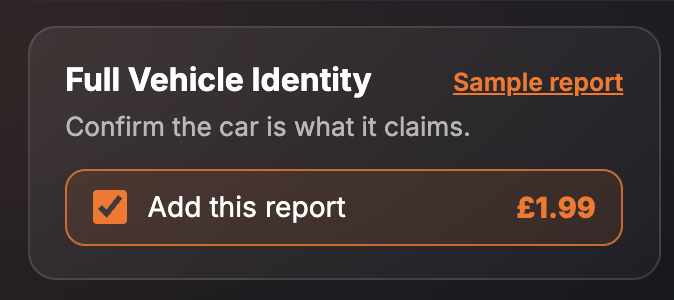
It is a single paid report inside the SortedCars Paid Check builder. You enter the registration, tick the check, and the report is built while you wait and shown on screen. It costs £1.99 on its own.
The card describes it in one line: “Confirm the car is what it claims.” The report header describes its coverage as “1 paid report” with the source shown as Experian, and carries the “NO DATA GUARANTEE” badge.
2. What the Report Shows
The finished report has seven sections, each drawn from the identity Experian holds for the registration. Every screenshot below is sample data from our test environment: the registration is an official DVLA test number and the plate mismatch, scrapped marker and investigation flag are fixed test records chosen to show what a bad result looks like, not a real car.
Section 1 — Vehicle Description. Make, Model, Fuel, Body, Transmission, Gears, Seats, Wheelplan, First registered (UK), First registered, Year of manufacture, CO2, Engine capacity and Record last updated. This is the car as the record describes it. Compare it with the car in front of you.
Section 2 — Identity & Matching. The heart of the report. It compares the registration, the VIN and the engine number with the record and gives a verdict.
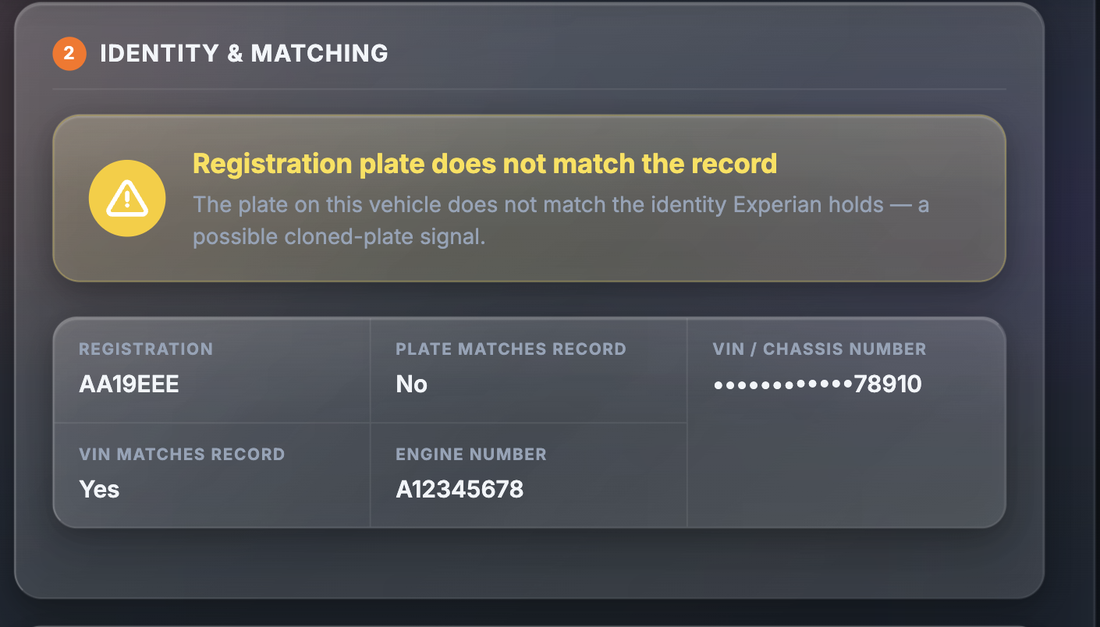
In the sample the verdict reads: “Registration plate does not match the record — The plate on this vehicle does not match the identity Experian holds — a possible cloned-plate signal.” The fields in this section are:
| Field | What it tells you |
|---|---|
| Registration | The plate you entered |
| Plate matches record | Yes or No — whether that plate matches the identity on record |
| VIN / chassis number | The chassis number on record, masked with the last 5 characters shown. Compare them with the V5C and the car |
| VIN matches record | Yes or No — whether the VIN matches the identity on record |
| Engine number | The engine number on record. Compare it with the V5C |
Section 3 — Status Markers. Scrapped, Scrapped date, Certificate of destruction issued, Currently exported, Previously exported, Exported date, Imported, Imported date, Non-EU import and Used before first registration. In the sample the verdict reads “Recorded as scrapped — DVLA holds a scrapped marker”. A car recorded as scrapped, with a certificate of destruction issued, should not be on sale at all.
Section 4 — Plate & Colour History. Previous GB registration, Previous NI registration, Current colour, Original colour and Previous colours (a count). The detailed change history is a separate check; this is the summary.
Section 5 — V5C & Physical Identity Checks. Logbooks issued, V5C issue dates, and an Identity check history with the date and result of each check. Compare the issue dates with the V5C in the seller’s hand; our V5C logbook guide explains what to look for.
Section 6 — Technical & Industry Codes. Door plan code, Transmission code, MVRIS manufacturer and model codes, DTP manufacturer and model codes, Maximum permissible mass, Power-to-weight ratio, Minimum kerb weight, Gross vehicle weight, Maximum net power, Max braked and unbraked towing weights, and the stationary and drive-by sound levels. These are the industry reference codes and weights for the car as recorded.
Section 7 — Full Vehicle Identity. The closing verdict on the whole identity.
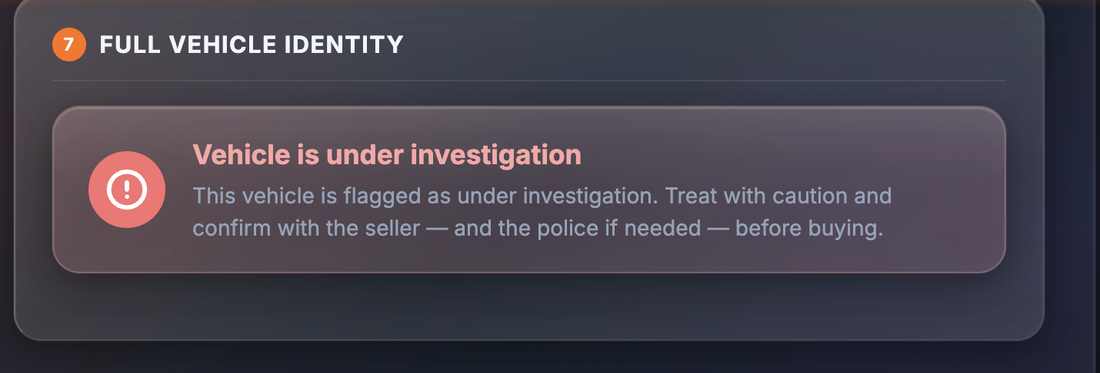
In the sample the verdict reads: “Vehicle is under investigation — This vehicle is flagged as under investigation. Treat with caution and confirm with the seller — and the police if needed — before buying.” The report closes with the line “Data provided by Experian”.
3. Why It Matters
A cloned car wears the plates of a genuine car of the same make, model and colour. Checked by registration alone, it looks clean, because the genuine car is clean. A ringed car has had its identity swapped, often onto a stolen car, so that the plate and the chassis number no longer belong together. In both cases the buyer pays for a car that is not what its paperwork says, and when the truth surfaces the car is recovered and the money is gone.
The defence is simple: the three identities must match each other and the record. Plate, VIN and engine number. This check does that comparison against the identity Experian holds, and then adds the markers that say whether that identity is still a live, saleable car: scrapped, exported, imported, and whether it is under investigation.
There is also a plainer reason. A seller whose car fails the identity match will have a story. The check gives you a fact to put against it, before you have paid anything. Our guide to spotting a cloned car covers the physical signs that go with the data.
4. Where the Data Comes From
The identity data in this check is provided by Experian. The report compares the registration you enter with the vehicle identity Experian holds and shows the result of each match, together with the status markers and the V5C history on that record.
SortedCars does not hold or create identity records. We ask Experian for the record on the car at the moment you build the report and show you every value we receive.
5. What It Cannot Tell You
An honest check comes with honest limits.
- It compares the record, not the car. The report tells you whether the plate, VIN and engine number on record belong together. Only you can check that the VIN on the car matches the one on the record. Section 6 explains where to look.
- The VIN is masked. The report shows the last 5 characters. That is enough to compare with the car and the V5C, but you cannot read the full chassis number from it.
- It is not a stolen, finance, write-off or mileage check. Those are separate reports on the same page. The Stolen Vehicle Check reads the Police National Computer marker; this check reads identity and status.
- It does not tell you the story behind a marker. “Under investigation” and “scrapped” are flags. The report cannot say why they were set.
- It is a snapshot. The result is correct at the moment the report is built.
Check a Car’s Full History
Check its history before you buy — free DVLA and MOT data in seconds.
6. What To Do If the Identity Does Not Match
Whether the report is clear or not, the last step is the same: check the record against the metal.
Step 1 — Find the VIN on the car. Look at the plate at the base of the windscreen, the stamping in the bodywork, and the label in the door shut. Compare the last five characters with the masked VIN on the report and with the V5C. Then compare the engine number on the V5C with the report.
Step 2 — Read the V5C properly. The seller should have the V5C in their name at the address you are standing at. Compare the logbook issue date with the V5C issue dates in section 5 of the report. The gov.uk guidance on buying a vehicle lists the checks to make on the logbook.
Step 3 — If the plate does not match the record, do not buy. A “No” in Plate matches record or VIN matches record is the signal of a cloned or ringed car. Do not confront the seller and do not go back. Report it to the police on 101 — police.uk explains how to reach your local force.
Step 4 — If the car is recorded as scrapped or under investigation, stop. A scrapped marker with a certificate of destruction means the DVLA was told the car was destroyed. An investigation flag means the report’s own advice applies: confirm with the seller and, if needed, the police before going further. Either way, do not pay until it is resolved to your satisfaction — and be ready for it not to be.
Step 5 — If you have already paid. Report it to the police on 101 first, then to Action Fraud. Keep the advert, your messages with the seller, the report and your payment record.
7. Price and Where It Sits
| How to buy it | Price | What you get |
|---|---|---|
| Full Vehicle Identity on its own | £1.99 | The seven identity sections shown above — description, identity matching, status markers, plate and colour summary, V5C history, technical codes and the closing verdict |
Add it to any other report on the Paid Check page, or pair it with the Stolen Vehicle Check and the VIN Decode for a full identity picture. Car Check Packs start at £2.99. Prices are as shown on the site at the time of writing; the page price is always the price you pay.
Final Thoughts
A car’s identity is the one thing a seller cannot polish. Plate, VIN and engine number either belong together or they do not, and the record either describes a live, saleable car or it does not.
The check costs £1.99 and is built while you wait. Run it before you view, take the last five characters of the VIN with you, and match them against the car and the V5C. If they line up, move on to the rest of the checks. If they do not, walk away and call 101.
This guide provides general information and is not legal advice. Identity data in the Full Vehicle Identity check is provided by Experian and compares the registration entered with the identity Experian holds at the time the report is built; it cannot confirm that the VIN on the car itself matches the record, which only a physical check can do. If a car’s plate or VIN does not match the record, do not buy it and contact the police on 101; if you have already paid, report it to the police and to Action Fraud. SortedCars resells the data named above and has no other connection with the providers, garages or insurers mentioned.
Frequently Asked Questions
Check Any Car’s History for Free
MOT history, mileage analysis, and DVLA data — completely free with SortedCheck.