A stolen car does not become yours because you paid for it. The person it was taken from is still the owner. If the police find it on your drive, they take it back, and the money you handed over goes with the seller. There is no protection in law for a buyer who unknowingly buys a stolen car: the loss is the buyer’s.
The Stolen Vehicle Check answers one question before you hand over any money: is this car flagged as stolen on the Police National Computer? This guide explains what the check shows, where the data comes from, what it cannot tell you, and what to do if the answer is yes.

1. What the Stolen Vehicle Check Is
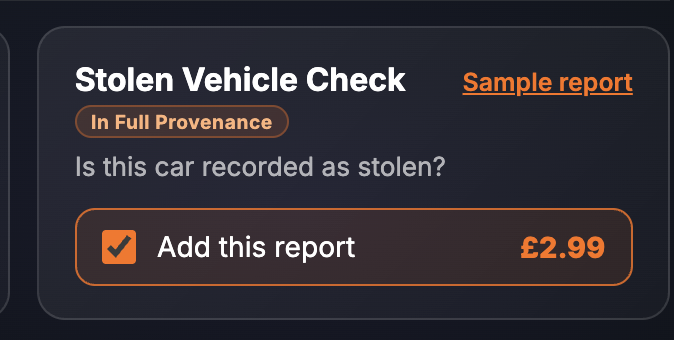
It is a single paid report inside the SortedCars Paid Check builder. You enter the registration, tick the check, and the report is built while you wait and shown on screen. It costs £2.99 on its own.
You will find it on the Provenance tab, in the Red flags group, next to the Outstanding Finance Check and the Mileage & Clocking Check. The card asks “Is this car recorded as stolen?” and carries the In Full Provenance badge, which means the same check is also included inside the Full Provenance Report.
2. What the Report Shows
The finished report opens with the vehicle details from the DVLA, then the six Experian identity sections (Vehicle Description, Identity & Matching, Status Markers, Plate & Colour History, V5C & Physical Identity Checks, and Technical & Industry Codes), and ends with the Stolen Vehicle Check section. The report header describes its coverage as “1 paid report + DVLA vehicle details” and shows the source as DVLA and Experian. Every screenshot below is sample data from our test environment: the registration is an official DVLA test number and the police force, contact number and dates are fixed test records, not a real car and not a real theft.
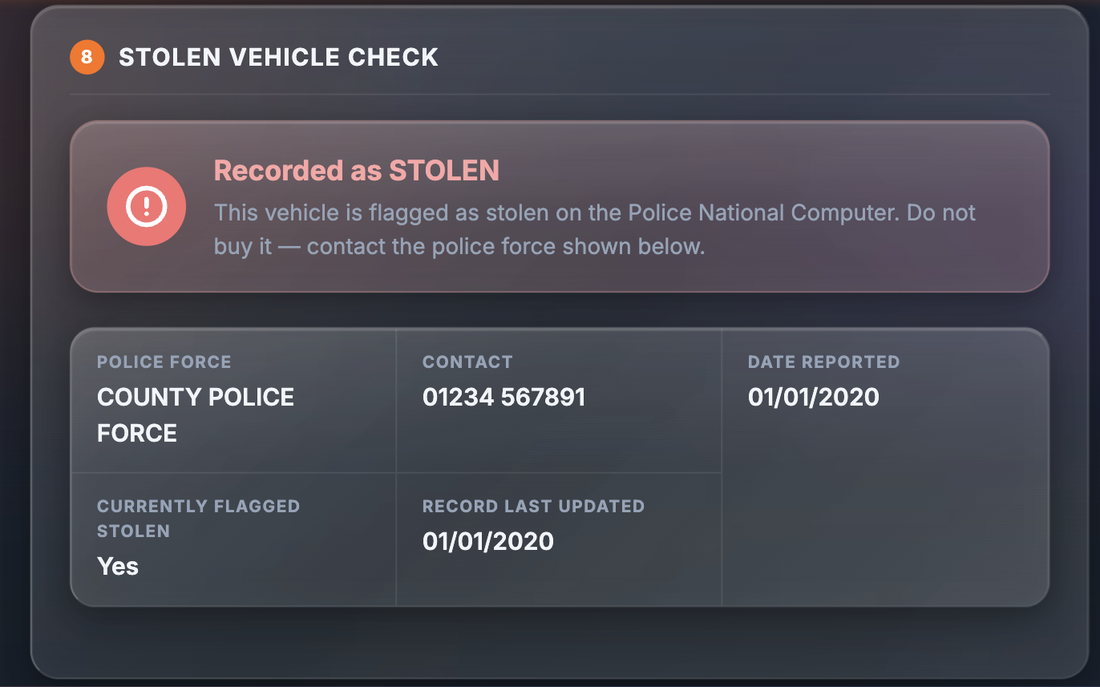
The section opens with a verdict. In the sample it reads: “Recorded as STOLEN — This vehicle is flagged as stolen on the Police National Computer. Do not buy it — contact the police force shown below.” Below the verdict, the report lists:
| Field | What it tells you |
|---|---|
| Police force | The force that recorded the theft — the force to contact |
| Contact | A phone number for that force |
| Date reported | When the theft was reported |
| Currently flagged stolen | Yes or No — whether the marker is live at the time the report is built |
| Record last updated | When the record was last updated |
The section carries the line “Data provided by Experian”. If no stolen marker is on record, the section says so plainly.
3. Why It Matters
Of all the things that can be wrong with a used car, a stolen marker is the one that costs you the whole car and gives nothing back. A finance problem can be settled. A write-off can be priced in. A stolen car is simply not the seller’s to sell, and it is not yours after you have paid.
The Police National Computer (PNC) holds the marker that says a vehicle has been reported stolen. When a car with a live marker is checked — at a roadside stop, by a camera, at an MOT — it is identified and recovered. The recovery does not depend on who is driving it or what they paid.
There is a second reason. Stolen cars are often sold quickly, at a price that seems too good, by a seller who wants cash and will not meet at their home. The check gives you a fact to set against the story. A live marker ends the conversation. A clear result is one part of the picture, alongside the identity sections and the V5C.
4. Where the Data Comes From
The stolen marker in this check is the Police National Computer stolen-vehicle marker, checked through Experian; the builder lists the source as “Experian (PNC)”. The vehicle details at the top of the report come from the DVLA.
SortedCars does not hold or create stolen-vehicle records. We ask Experian for the record on the car at the moment you build the report and show you every value we receive.
5. What It Cannot Tell You
An honest check comes with honest limits.
- A clear result means no PNC stolen marker at the time of the check. A car stolen after the check, or stolen but not yet reported, will not show. Run the check close to the day you pay.
- A cloned car passes under the plate it is wearing. A cloned car carries the registration of a genuine car of the same make, model and colour. The stolen check is run against the plate you enter, so the genuine car’s clear record comes back. That is why the Identity & Matching section — plate against VIN — is in the same report. Our guide to spotting a cloned car shows what to look for.
- It does not tell you the story. The report shows the force, the date and whether the marker is live. It does not say how the car was taken or from whom.
- It is a snapshot. The result is correct at the moment the report is built.
- It is not a finance, write-off or mileage check. Those are separate reports on the same page. The Full Provenance Report bundles them together with the stolen check for £5.99.
Check a Car’s Full History
Check its history before you buy — free DVLA and MOT data in seconds.
6. What To Do If a Stolen Marker Is Found
This is the one result where there is no negotiation and no second step with the seller.
Step 1 — Do not buy the car. The verdict says so in its own words. No price, no explanation and no paperwork changes a live stolen marker.
Step 2 — Do not confront the seller. You do not know who they are or how they came by the car. Do not tell them what the report says, do not argue, and do not go back to see the car again. Make an excuse and leave.
Step 3 — Report it to the police. Contact the police force shown on the report using the contact number listed, or call 101 — police.uk explains how to reach your local force. Give them the registration, the seller’s details as you have them, the advert, and where and when you saw the car.
Step 4 — If you have already paid, report the sale as well. Contact the police on 101 first. Then report the purchase to Action Fraud, which handles fraud and buying scams. Keep the advert, your messages with the seller, the report and any payment record.
If the stolen check is clear but the Identity & Matching section shows the plate does not match the VIN, treat it the same way: do not buy, do not confront, and report it on 101. A plate that does not match the record is the signature of a cloned car.
7. Price and Where It Sits
| How to buy it | Price | What you get |
|---|---|---|
| Stolen Vehicle Check on its own | £2.99 | The stolen section plus the DVLA vehicle details and Experian identity sections shown above |
| Full Provenance Report | £5.99 | Stolen, finance, write-off, mileage, keeper and plate history in one report — provenance data provided by Experian |
The stolen check is not sold inside a Car Check Pack on its own, but every pack from the Essential Pack (£5.99) upwards includes the Full Provenance Report, so the stolen check is inside all of those too. Prices are as shown on the site at the time of writing; the page price is always the price you pay.
Final Thoughts
A stolen car is the one used-car problem with no fix. The check that finds the marker costs £2.99 and is built while you wait. Run it close to the day you pay, read the Identity & Matching section in the same report, and check the V5C against both.
If the marker is live, do not buy, do not confront, and call 101. If it is clear and the identity matches, you have done what a careful buyer can do. Then buy the car.
This guide provides general information and is not legal advice. The stolen marker in the Stolen Vehicle Check is the Police National Computer stolen-vehicle marker, checked through Experian at the time the report is built; it cannot show a theft not yet reported, and a cloned car wearing a genuine car’s plate will return that car’s record. If a car is flagged as stolen, do not buy it and contact the police on 101; if you have already paid, report it to the police and to Action Fraud. SortedCars resells the data named above and has no other connection with the providers, garages or insurers mentioned.
Frequently Asked Questions
Check Any Car’s History for Free
MOT history, mileage analysis, and DVLA data — completely free with SortedCheck.