A car written off by an insurer does not stop existing. Depending on the category it is scrapped, broken for parts, or repaired and put back on the road. A repaired write-off can be a usable car at the right price. It is not the same as a car that has never been damaged, and should not be priced as one.
The Write-off & Salvage Check answers one question before you hand over any money: has this car been recorded as an insurance loss, or sold through a salvage auction? This guide explains what the two parts show, what the categories mean, where the data comes from, and what to do if a record is found.

1. What the Write-off & Salvage Check Is
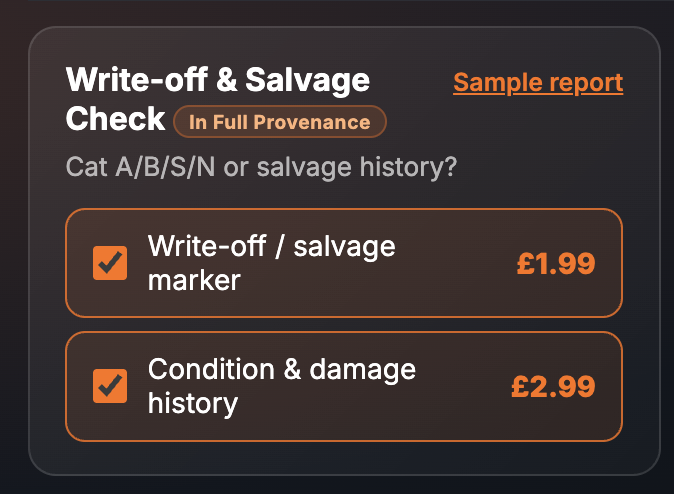
It is a paid report inside the SortedCars Paid Check builder, sold in two parts that you can tick separately or together. You enter the registration, tick one or both, and the report is built while you wait and shown on screen. The Write-off / salvage marker costs £1.99 and the Condition & damage history costs £2.99.
You will find the card on the Provenance tab, in the Red flags group, next to the Outstanding Finance Check and the Safety Recall Check. The card asks “Cat A/B/S/N or salvage history?” The “In Full Provenance” badge means both parts are also included inside the Full Provenance Report.
2. What the Report Shows
With both parts ticked the report header shows the coverage as “2 paid reports + DVLA vehicle details”, the source as “DVLA · CarGuide · Experian”, and a “NO DATA GUARANTEE” badge. Because the Condition & damage history part comes from Experian, the report also carries the six Experian identity sections. Every screenshot below is sample data from our test environment: the registration is an official DVLA test number and the categories, dates, insurer and claim number are fixed test records, not a real car or insurer.
Part one: the Write-off / salvage marker. This part reads salvage auction records. If the car has been through a salvage sale, the verdict says “Listed in a salvage auction” and explains that this usually means it was written off and sold for repair or parts.
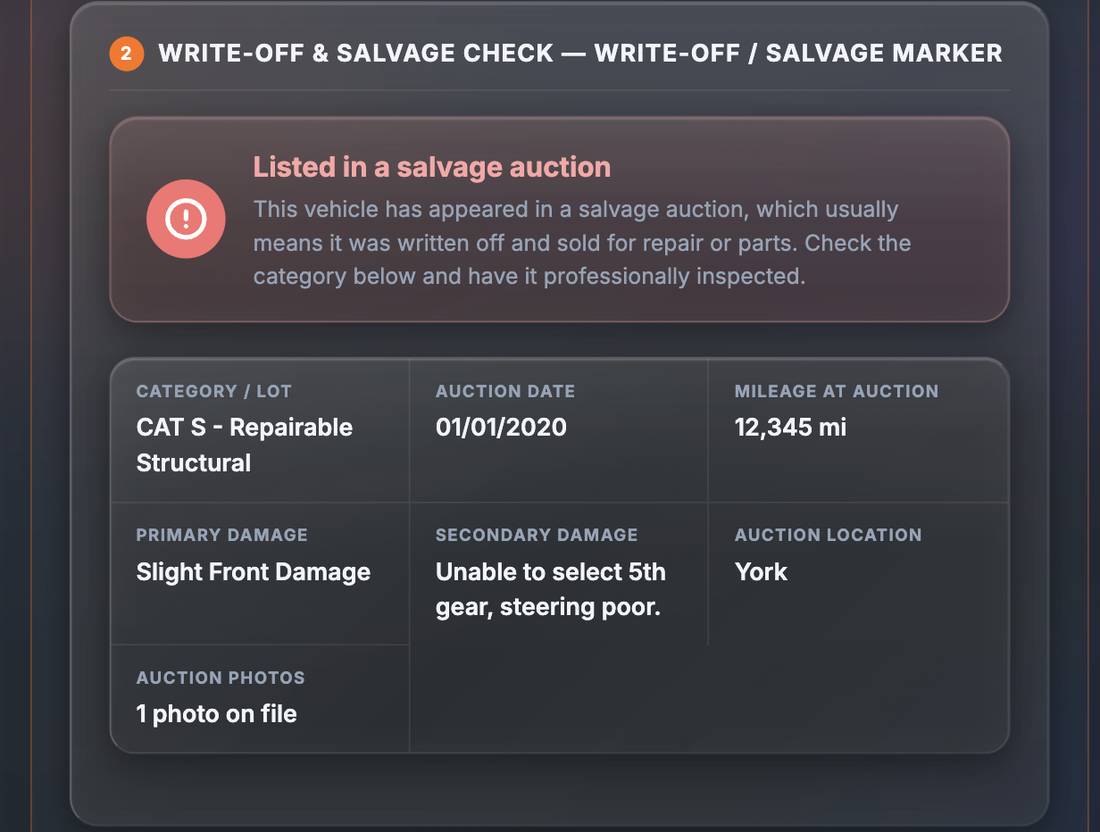
| Field | What it tells you |
|---|---|
| Category / lot | The salvage category the car was sold under, for example “CAT S — Repairable Structural” |
| Auction date | When the car went through the salvage sale |
| Mileage at auction | The odometer reading recorded at the sale — compare it with the mileage today |
| Primary damage | The main damage recorded by the auction |
| Secondary damage | Free-text notes on other faults noted at the sale |
| Auction location | Where the sale took place |
| Auction photos | How many photos the auction has on file |
Part two: the Condition & damage history. This part reads the Motor Insurance Anti-Fraud and Theft Register (MIAFTR), the insurance industry’s register of loss records. If a record exists, the verdict says “Insurance write-off / damage recorded” with the category.
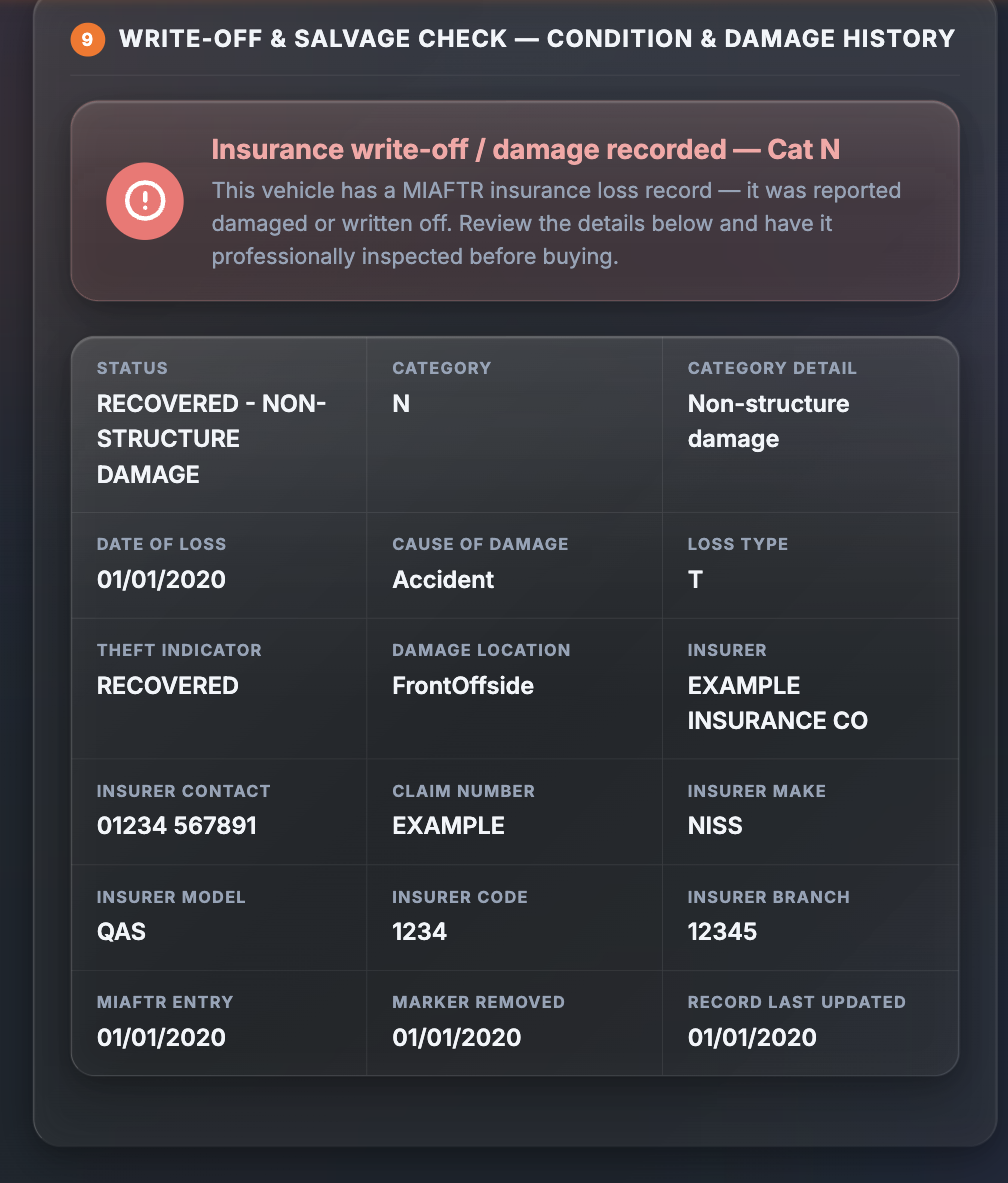
| Field | What it tells you |
|---|---|
| Status | The insurer’s status wording, for example “RECOVERED — NON-STRUCTURE DAMAGE” |
| Category | The write-off category: A, B, S or N |
| Category detail | What the category means in words |
| Date of loss | When the damage or loss happened |
| Cause of damage | What caused it, for example accident |
| Loss type | The insurer’s loss-type code |
| Theft indicator | Whether the loss involved a theft, and whether the car was recovered |
| Damage location | Where on the car the damage was, for example front offside |
| Insurer, Insurer contact, Claim number | Who recorded the loss, how to contact them, and their claim reference |
| Insurer make, Insurer model, Insurer code, Insurer branch | The vehicle and office details as the insurer recorded them |
| MIAFTR entry | When the record was added to the register |
| Marker removed | When a marker was lifted, if it has been |
| Record last updated | When the insurer last updated the record |
Each part ends with its own “Data provided by” line: CarGuide for the first, Experian for the second. If neither finds a record, each section says so plainly.
3. Why It Matters
Since October 2017 the insurance industry has used four salvage categories. Cat A is scrap only: nothing from the car should be reused. Cat B means the car can be broken for parts, but the shell must be crushed. Cat S is structurally damaged but repairable. Cat N is non-structural damage, repairable. Older records may show the earlier categories C and D.
A Cat A or Cat B car should not be on the road at all. A Cat S or Cat N car can be legally driven once repaired, and a Cat S car must be re-registered with the DVLA so that the V5C and the DVLA record are updated. Even repaired properly, a written-off car is worth less than an undamaged one, and some insurers will not cover a Cat S or Cat N car. If you did not know about the write-off when you bought, you paid the wrong price and may get an insurance surprise later.
4. Where the Data Comes From
The two parts come from two providers. The Write-off / salvage marker is provided by CarGuide and reads salvage auction records. The Condition & damage history is provided by Experian and reads the MIAFTR register, where insurers record vehicles they have written off or paid a loss on. The vehicle details at the top of the report come from the DVLA.
SortedCars does not hold or create salvage or insurance loss records. We ask CarGuide and Experian for the records on the car at the moment you build the report and show you every value we receive.
5. What It Cannot Tell You
An honest check comes with honest limits.
- Only recorded losses and sales appear. A car damaged and repaired privately, with no insurance claim and no salvage sale, leaves no record for either part to find.
- It does not inspect the repair. A record tells you the car was damaged. Whether it was put right properly is a job for a qualified inspector.
- The two sources can disagree. One part finding a record and the other not is a reason to dig further, not to pick the answer you prefer.
- It is a snapshot. The result is correct at the moment the report is built. Run it close to the day you pay.
- It is not a finance, stolen or mileage check. Those are separate reports on the same page. The Full Provenance Report bundles them together with both parts of this check for £5.99.
Check a Car’s Full History
Check its history before you buy — free DVLA and MOT data in seconds.
6. What To Do If a Record Is Found
A write-off record is not automatically the end of the deal. The category, the repair and the price are what matter.
Step 1 — Check the category. Cat A or Cat B: walk away. Cat S or Cat N: continue, with care.
Step 2 — Check the seller told you. If the advert described the car as never damaged, you have learned something about the seller. Ask them to explain the record first.
Step 3 — Check the V5C. A Cat S car must be re-registered, so the DVLA record and logbook should reflect it. Compare the V5C with the report; gov.uk/buy-a-vehicle lists the checks the DVLA recommends.
Step 4 — Get it inspected. Both verdicts on the report say the same thing: have it professionally inspected. For a Cat S car, that means someone qualified to look at structural repairs.
Step 5 — Check you can insure it, then price it. Ask your insurer whether they will cover that category, and at what cost, before you commit. Then negotiate a price that reflects a repaired write-off.
If you have already bought a car described as undamaged and the report shows otherwise, Citizens Advice can explain your rights, and a deliberate deception can be reported to Action Fraud. A dispute with an insurer about how a loss was recorded goes to the insurer first and then to the Financial Ombudsman Service.
7. Price and Where It Sits
| How to buy it | Price | What you get |
|---|---|---|
| Write-off / salvage marker on its own | £1.99 | The salvage auction section plus the DVLA vehicle details — data provided by CarGuide |
| Condition & damage history on its own | £2.99 | The MIAFTR section plus the DVLA vehicle details and Experian identity sections — data provided by Experian |
| Full Provenance Report | £5.99 | Both parts, plus finance, stolen, mileage, keeper and plate history in one report — provenance data provided by Experian |
Neither part is sold inside a Car Check Pack on its own, but the Full Provenance Report that contains both is inside the packs from the Essential Pack (£5.99) upwards. Prices are as shown on the site at the time of writing; the page price is always the price you pay.
Final Thoughts
The check that finds a write-off reads two sources for £1.99 and £2.99 and is built while you wait. Tick both parts, read the category and the damage fields, and take the report’s own advice: have the car professionally inspected before buying.
Cat A and Cat B: walk away. Cat S and Cat N: inspect, insure, then price it as what it is. A repaired write-off bought with open eyes is a fair deal. The same car bought as undamaged is not.
This guide provides general information and is not legal or insurance advice. The Write-off / salvage marker is provided by CarGuide from salvage auction records and the Condition & damage history is provided by Experian from the MIAFTR insurance loss register; each shows what its source held at the time the report is built, cannot show damage that was repaired without a claim or a salvage sale, and does not assess the quality of any repair. Whether an insurer will cover a Cat S or Cat N car is the insurer’s decision; disputes with an insurer go to the insurer first and then the Financial Ombudsman Service. SortedCars resells the data named above and has no other connection with the providers, garages or insurers mentioned.
Frequently Asked Questions
Check Any Car’s History for Free
MOT history, mileage analysis, and DVLA data — completely free with SortedCheck.